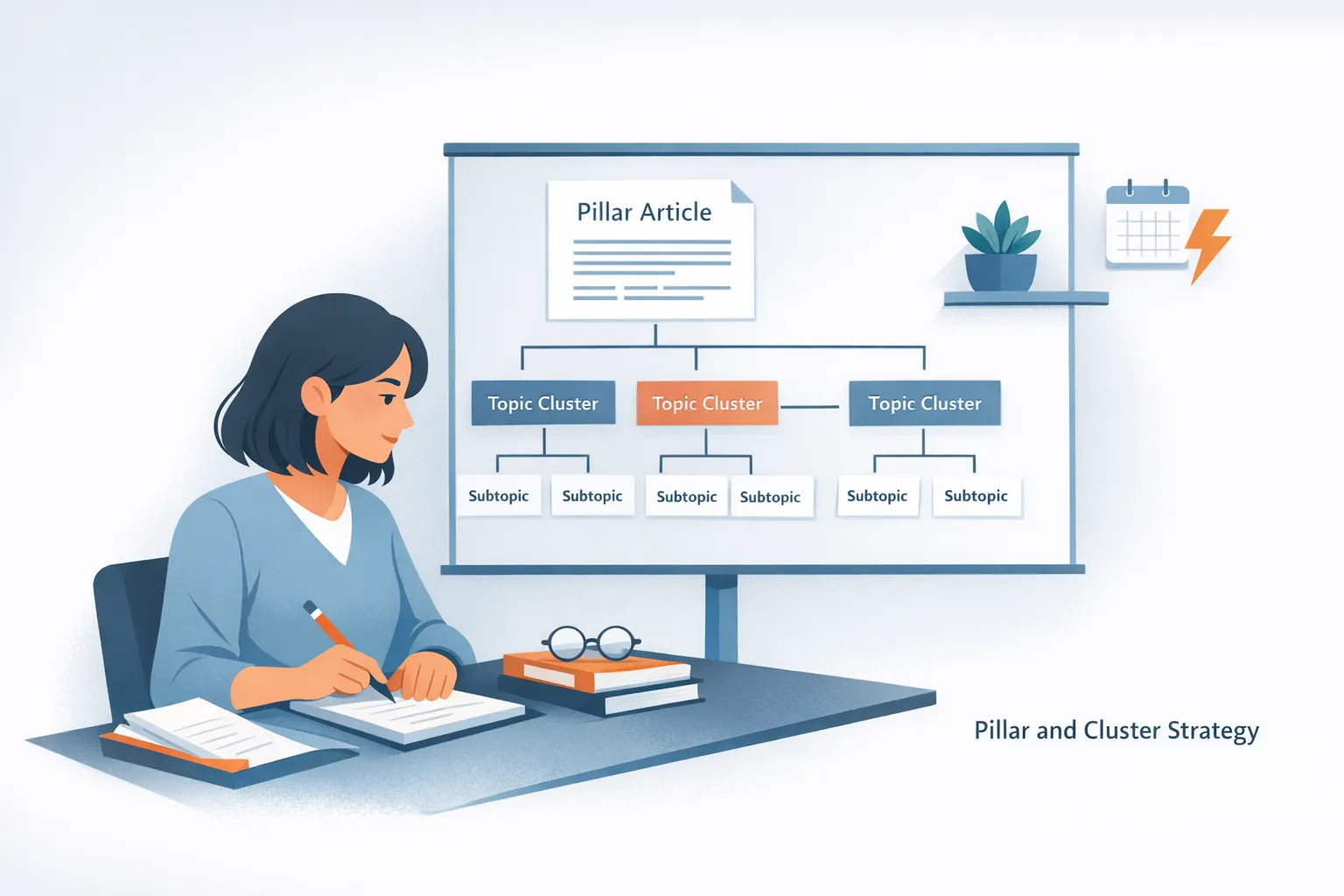
To plan a 30-day topical cluster sprint, define a pillar topic and select four to six supporting cluster topics. You will map each cluster to a target keyword and user intent, then build a tight 30-day calendar that moves research, outlines, drafting, editing, and publication through parallel tracks. Assign owners, set realistic daily tasks, and lock in an internal linking plan from every cluster post back to the pillar. Run quick SEO checks on each piece, prepare assets, and schedule publication and promotion. Finish with a sprint retrospective to capture lessons and improve the next cycle. The keyword is 30-day topical cluster sprint, and this approach keeps content aligned, scalable, and optimized for both search engines and readers.
This is for you if:
- You manage a content team or work solo to scale SEO content around a pillar topic .
- You want a structured, repeatable 30-day sprint framework that ties research to publishing.
- You need to balance speed with quality, ensuring internal linking and on-page optimization.
- You seek a cycle-based approach aligned to a calendar month or content cycle.
- You’re comfortable with coordinating owners, timelines, and brief standards.

Prerequisites to Plan a 30-Day Topical Cluster Sprint
Prerequisites matter because they set the foundation for a focused, scalable sprint. By clarifying the pillar topic, selecting 4–6 cluster topics, and lining up keyword intent, you reduce rework and accelerate publishing. With a solid calendar, defined responsibilities, and an internal linking plan, you create a repeatable workflow that scales across cycles. Having these elements in place helps you hit your SEO and audience goals faster.
Before you start, make sure you have:
- A clearly defined pillar topic that anchors the sprint.
- 4–6 supporting cluster topics that branch from the pillar.
- A 30-day content calendar template covering research, outlines, drafting, editing, and publication.
- Access to keyword research tools and guidance on search intent.
- Assigned owners for the pillar, cluster topics, and SEO tasks.
- An initial internal linking plan connecting clusters to the pillar.
- A baseline on-page SEO checklist for all posts (titles, headers, meta).
- Collaboration tools and a workflow for drafting, editing, and publishing.
- A plan for research, outlines, drafts, revisions, and publish windows.
- Access to guidance or examples from The Marketing Knot .
- A readiness to adapt the plan based on performance and learnings.
Execute a Ready-to-Use Plan for a 30-Day Topical Cluster Sprint
Begin by mapping a solid pillar topic to a practical sprint plan, then align cluster topics, keywords, and intent so every piece reinforces the pillar. Set expectations for collaborative work, clear responsibilities, and a publishing rhythm that keeps momentum without overloading the team. Focus on actionable steps, concrete milestones, and regular check-ins to ensure the content remains aligned with audience needs and SEO goals. This procedure emphasizes speed with quality, repeatability, and a clear path from research to publication to help you scale topical authority efficiently.
-
Define pillar and sprint goal
Clarify the pillar topic and set a concrete sprint goal aligned with business priorities. This alignment guides topic selection, content scope, and the internal-linking plan. Define success criteria for the sprint so the team knows when work is complete. Confirm the pillar-to-cluster structure and assign initial owners and deadlines.
How to verify: A documented pillar statement, sprint goal, and ownership matrix exist.
Common fail: Goals are vague or ownership is unclear.
-
Identify cluster topics and map to pillar
Brainstorm 4–6 cluster topics that naturally extend the pillar. Create a map linking each cluster to the pillar and defining a primary keyword and intent. Ensure topics cover a range of angles and facilitate strong internal linking. Assign owners and set initial deadlines.
How to verify: Cluster-topic map shows clear pillar connections and owner assignments.
Common fail: Clusters do not align with the pillar or lack defined owners.
-
Research keywords and establish intent per topic
Review keyword guidance to identify search intent, volume, and competitiveness. Document primary and secondary keywords and the user intent for each topic. Note semantic terms to enrich content and support related queries. Review keyword guidance in line with the 30 Day Sprint Productivity Method. Source
How to verify: Each cluster has defined target keywords and stated user intent.
Common fail: Keywords lack clear intent alignment or coverage gaps exist.
-
Build calendar and assign owners
Create a day-by-day calendar that schedules research, outlines, drafting, editing, and publication. Assign each task to a responsible owner and set calendar deadlines. Ensure dependencies are visible and manageable to prevent bottlenecks.
How to verify: Calendar shows assigned owners and achievable deadlines for all tasks.
Common fail: Overlapping responsibilities or unclear due dates create delays.
-
Outline each post with SEO and user intent in mind
Draft outlines that reflect pillar and cluster intent, with clear target headers and meta directions. Map the outline to SEO signals and user questions to improve relevance. Prepare briefs that guide writers on tone, format, and internal linking opportunities.
How to verify: Outlines include headings, intent notes, and linking opportunities.
Common fail: Outlines are generic and miss audience questions or internal link paths.
-
Draft, optimize, and QA content
Write drafts following outlines, applying on-page SEO basics and accessibility considerations. Run quality assurance checks for readability, factual accuracy, and internal links. Iterate with edits until content meets agreed standards.
How to verify: All posts pass QA checks and contain approved SEO elements.
Common fail: Skipping edits or neglecting on-page optimization.
-
Publish cluster pages and internal linking
Publish each cluster post on schedule and implement the internal linking path to the pillar. Validate that links are functional, crawlable, and correctly indexed. Update navigation or sitemaps if needed to reflect the new structure.
How to verify: All cluster pages are published with correct internal links to the pillar.
Common fail: Broken links or missing internal link paths reduce link equity.
-
Review performance and plan the next sprint
Track key metrics, capture learnings, and summarize what worked or needs adjustment. Use insights to refine pillar topics, cluster breadth, and the publishing cadence for the next cycle.
How to verify: A post-sprint retrospective with actionable takeaways is documented.
Common fail: Missing or vague learnings that don’t inform future sprints.
-
Communicate progress and align stakeholders
Share progress updates with relevant teams, confirm next steps, and secure approval for the upcoming sprint plan. Maintain transparency to sustain momentum and support.
How to verify: Stakeholders approve the next sprint plan and milestones.
Common fail: Poor stakeholder visibility leads to misaligned expectations.
Verification: Confirm a Successful 30-Day Topical Cluster Sprint
To confirm success, review that the pillar and clusters are clearly linked, keywords and intents are defined for each topic, and the sprint calendar shows assigned owners and deadlines. Check that outlines exist for every post, drafts pass SEO and QA, and publications occur on schedule with functioning internal links. Finally, verify a sprint retrospective captures learnings and actions for the next cycle. This verification approach aligns with established sprint methods to ensure repeatable, scalable results and ongoing improvement Source .
- Pillar-to-cluster mapping completed
- 4–6 cluster topics linked to pillar
- Target keywords and intents defined for each topic
- 30-day calendar with owner assignments
- Outlines ready for all posts
- Drafts reviewed and SEO-checked
- Cluster pages published on schedule
- Internal linking from clusters to pillar in place
- Promotional plan scheduled
- Sprint retrospective documented
- Learnings fed into next sprint plan
| Checkpoint | What good looks like | How to test | If it fails, try |
|---|---|---|---|
| Pillar-to-cluster mapping confirmed | All clusters anchored to the pillar with a documented structure | Review mapping document and verify links exist from clusters to the pillar | Revisit pillar scope and re-map clusters with stakeholders |
| Keywords and intents defined for each topic | Each topic has a primary keyword and a stated user intent | Audit keyword lists against briefs; confirm alignment with intent | Re-run keyword research and adjust briefs accordingly |
| 30-day calendar with owners | Calendar shows dates, tasks, owners, dependencies | Inspect calendar for assignments and gaps; confirm dependencies | Re-assign resources and resequence tasks |
| Outlines ready for all posts | Outlines include headers, meta directions, and linking opportunities | Outline checklist review; ensure pillar and cluster linkage is explicit | Revise briefs and rework outlines |
| SEO and QA completed before drafting | All posts pass on-page SEO and accessibility checks | Run SEO checklist and QA reviews | Address issues and postpone drafting until fixes are complete |
| Publish and retrospective completed | All posts published; internal links live; retrospective documented | Verify publish timestamps and link indices; review retrospective | Adjust publication queue and capture next-step actions |
Troubleshooting: Quick Fixes for a 30-Day Topical Cluster Sprint
When momentum stalls or outcomes drift, use these symptom-focused fixes to diagnose and address blockers quickly. This guidance helps you maintain pillar integrity, keep to schedule, and preserve SEO health across the sprint by targeting alignment, workload balance, and quality checks. Apply the actionable steps here to restore flow, reduce rework, and sustain momentum from research through publication.
-
Symptom:
Pillar-to-cluster mapping is unclear or broken.
Why it happens: Clusters aren’t tightly anchored to the pillar, or the scope drifted during ideation.
Fix: Revisit the pillar definition and create a simple map showing how each cluster supports the pillar. Confirm with stakeholders and update briefs accordingly.
-
Symptom:
Too few or poorly defined cluster topics.
Why it happens: Brainstorming was limited; scope creep; no anchor to the pillar.
Fix: Run a quick ideation pass to generate 1–2 additional clusters; ensure each cluster has a clear angle and intent.
-
Symptom:
Keyword intents not aligned to topics.
Why it happens: Misalignment between topic and search intent; keywords too broad or vague.
Fix: Reassess keyword guidance; assign primary keywords and explicit intents for each cluster; update briefs.
-
Symptom:
Schedule bottlenecks or unclear ownership.
Why it happens: Unclear responsibilities; dependencies not mapped.
Fix: Assign owners for each pillar and cluster; set fixed deadlines; map dependencies in a shared calendar.
-
Symptom:
Outlines missing SEO signals or linking opportunities.
Why it happens: Briefs are incomplete; no internal linking plan.
Fix: Update outlines to include target headers and meta cues; map internal links to pillar; create a linking plan.
-
Symptom:
Drafts failing QA or SEO checks.
Why it happens: Quality standards not defined or applied; readability or accessibility gaps.
Fix: Implement a lightweight QA checklist; require SEO review before drafting; assign a second reviewer.
-
Symptom:
Publications delayed or broken links.
Why it happens: Publishing queue not followed; links not tested; indexing delays.
Fix: Create a publish queue; test all links; monitor indexing and fix broken links.
-
Symptom:
Sprint retrospective missing or not actionable.
Why it happens: No formal process to capture learnings; actions remain vague.
Fix: Schedule a retrospective; document 3–5 concrete actions for next sprint; assign owners.
-
Symptom:
Insufficient stakeholder visibility.
Why it happens: Status updates are infrequent; expectations drift.
Fix: Schedule regular stakeholder readouts; share progress; secure approvals for upcoming milestones.
What readers ask next about planning a 30-day topical cluster sprint
- How do I start the sprint? Begin by selecting a pillar topic, then choose four to six cluster topics that clearly extend the pillar. Create a simple 30‑day calendar that assigns owners and milestones for research, outlines, drafts, and publishing.
- How many clusters should I plan? Plan four to six clusters to ensure depth without spreading resources too thin. Each cluster should have a distinct angle that ties back to the pillar.
- How do I map keywords and intent? Assign a primary keyword and explicit user intent for each cluster, and ensure every outline and draft aligns with that intent and serves the pillar.
- What belongs in the 30-day calendar? A rhythm of research, outlines, drafting, editing, and publication windows, with clear owners and realistic deadlines for each task.
- How should internal linking be planned? Map links from cluster posts to the pillar and between related clusters to reinforce topical authority before publishing.
- What metrics indicate success? Clear pillar-to-cluster mapping, defined intents and keywords, a complete calendar, published posts, and a documented sprint retrospective with next-step actions.
- What should I do if a post underperforms? Revisit the target keyword and intent, update the brief, and adjust the surrounding cluster content in the next sprint iteration.
- What are common pitfalls to avoid? Vague pillar definitions, unclear ownership, missing SEO checks, weak linking plans, and rushing publication.
Common questions about planning a 30-day topical cluster sprint
-
How do I start the sprint?
Begin by defining a pillar topic and a clear sprint goal that aligns with business priorities. Select four to six cluster topics that naturally extend the pillar and set a simple 30-day calendar that assigns owners and milestones for research, outlines, drafting, and publishing. Establish an internal linking plan from each cluster back to the pillar and identify essential stakeholders to engage early. This upfront setup keeps effort focused and scalable.
-
How many clusters should I plan?
Plan four to six clusters to ensure depth without spreading resources too thin. Each cluster should offer a distinct angle that ties back to the pillar, which helps maintain topical authority and a coherent user journey. Confirm team capacity, assign clear owners, and create a light dependency map so teams can coordinate without bottlenecks. This framing supports consistent velocity across the sprint.
-
How do I map keywords and intent?
Map keywords and intent by assigning a primary keyword and explicit user intent for each cluster. Ensure outlines, drafts, and metadata align with that intent and reinforce the pillar. Include semantic terms and related queries to broaden coverage and support long-tail opportunities. Regularly review alignment as topics evolve during research and drafting. Keep a living brief for each post that references the pillar.
-
What belongs in the 30-day calendar?
Create a rhythm that covers research, outlines, drafting, editing, and publication windows. Assign owners, set realistic deadlines, and flag dependencies early. Build in buffer for QA and revision cycles, plus parallel tracks for writing and optimization. Use the calendar to track progress, surface bottlenecks, and keep momentum from discovery to publish.
-
How should internal linking be planned?
Plan a deliberate linking strategy that connects cluster posts to the pillar and to related clusters. Map link paths before drafting, reserve anchor text, and ensure every post has at least one link to the pillar. Regularly audit links for crawlability and indexing status to maintain topical authority.
-
What metrics indicate success?
Look for explicit pillar-to-cluster mappings, defined intents and keywords, a complete calendar, published posts, and a documented sprint retrospective. Track on-page SEO elements, internal link completion, and publication cadence. Use this data to judge velocity, accuracy, and whether the cluster supports the pillar’s authority.
-
What should I do if a post underperforms?
Revisit the target keyword and intent for the underperforming post, update the brief, and adjust the surrounding cluster content in the next sprint iteration. Compare with top performers to identify gaps in angle or depth, then run a quick revision cycle focusing on intent alignment and link opportunities.
-
What are common pitfalls to avoid?
Avoid vague pillar definitions, unclear ownership, missing SEO checks, weak linking plans, and rushing publication. Ensure every topic stays anchored to the pillar, maintain clear responsibilities, and complete essential QA checks before going live. Build in time for retrospective learnings so future sprints improve consistently.