This case study snapshot for content audit case study for small sites follows a single-owner local service business experimenting with a lean audit. The customer archetype is a local service business with a tiny team, limited budget, and a basic CMS. They aimed to boost organic visibility and conversions by turning an underutilized content library into a coherent, higher quality asset that serves both readers and search engines. The approach was to conduct a lean content audit focused on establishing a minimal inventory, creating two to three topic clusters, and enforcing a simple heading and internal linking framework. Changes included standardizing headlines, mapping posts to clusters, and building a scalable process for regular updates and repurposing. Why it mattered: the changes clarified audience needs, improved navigation, and reduced duplication, enabling faster iteration with minimal resources. The outcome preview shows stronger content governance, more consistent user journeys, and a repeatable workflow that can scale as the site grows.
Snapshot:
- Customer: archetype only
- Goal: Increase organic visibility and generate more inquiries or sales by building two core business-aligned goals and a repeatable audit process
- Constraints: Limited budget; small team; minimal tooling; tight timelines; reliance on basic analytics and CMS
- Approach: Lean inventory; cluster mapping; simple headings; lightweight internal linking; governance; templates
- Proof: describe evidence types used
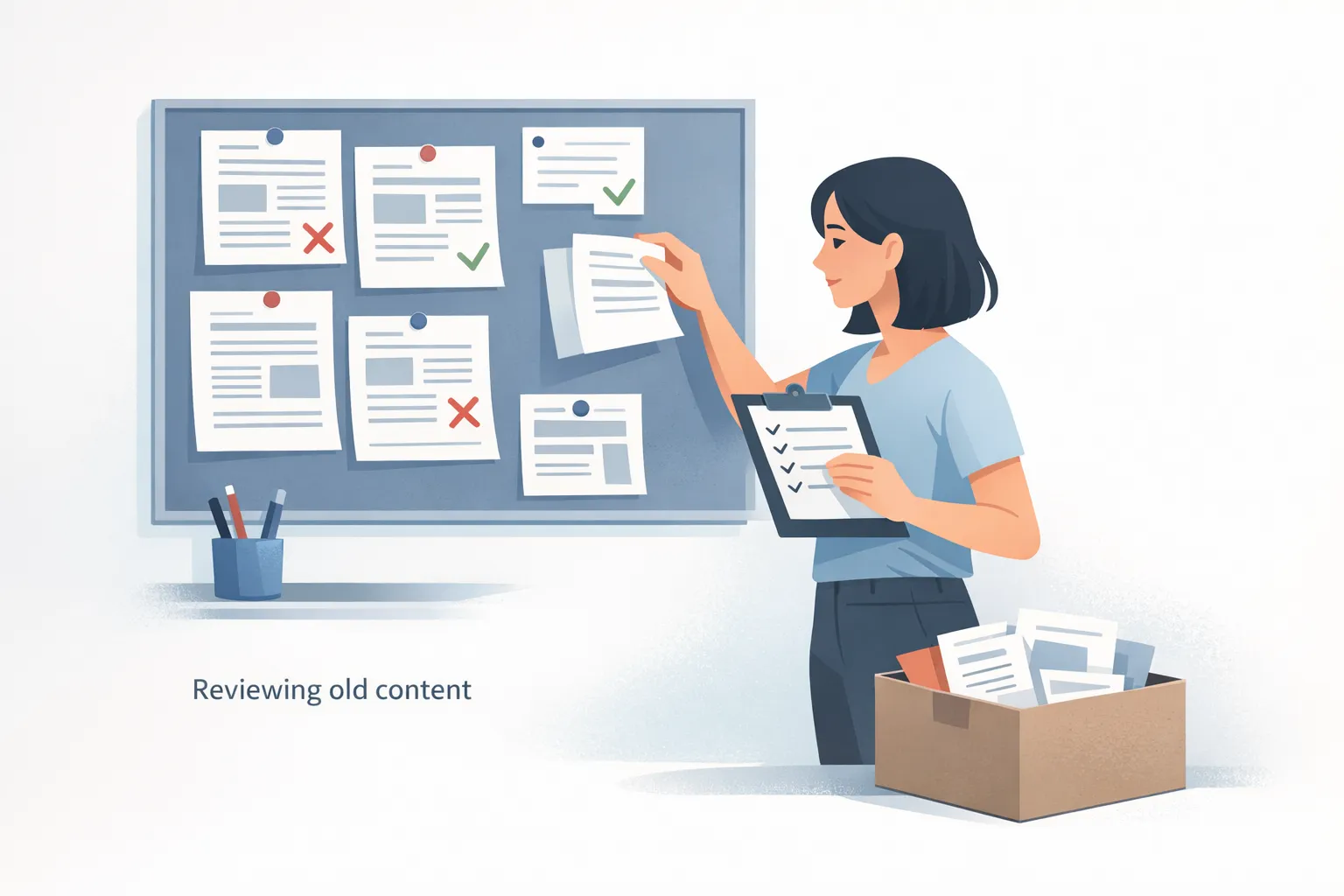
Context and Constraints That Shaped the Small Site Content Audit
The case study centers on a small, independent local service business operated by a single person who also handles most content creation and customer interactions. The site had a modest blog and service pages, built on a basic CMS with limited customization options and a lean habit of publishing. The environment demanded practical, repeatable processes rather than big-budget experiments, and the owner faced competing priorities of client work, scheduling, and marketing tasks. The overarching goal was to improve organic visibility and inbound inquiries without expanding the team or purchasing new tools, relying instead on a disciplined, lightweight audit that could be sustained over time. In this context, even small improvements to structure, clarity, and navigation could yield meaningful returns without disrupting existing operations. The scenario illustrates how a one person operation can elevate content quality by following a tight, outcome-driven plan rather than a broad, resource-heavy overhaul.
The project aimed to transform a scattered content library into a coherent asset that serves both readers and search engines. With a constrained budget and minimal tooling, the team sought to establish two business-aligned goals, implement a simple inventory, and define two to three topic clusters. The emphasis was on actionable steps that could be executed within a few hours per week, producing tangible governance and repeatable workflows. The broader implication was to demonstrate how a lean audit can create a scalable foundation for ongoing content optimization as the site grows.
The decision to pursue a lean content audit reflected a belief that meaningful gains come from clarity, not complexity. By focusing on core topics, consistent headings, and a practical internal linking plan, the site could improve reader navigation, topic authority, and content lifespan. The approach prioritized sustainability over speed, aiming to deliver repeatable results that would endure beyond the initial audit while staying within the constraints of a one-person operation.
Snapshot:
- Customer: archetype only
- Goal: Increase organic visibility and generate more inquiries or sales by building two core business-aligned goals and a repeatable audit process
- Constraints: Limited budget; small team; minimal tooling; tight timelines; reliance on basic analytics and CMS
- Approach: Lean inventory; cluster mapping; simple headings; lightweight internal linking; governance; templates
- Proof: describe evidence types used
A Lean Strategy Signals a Practical; Structured Approach
The team chose to start with a lean inventory of onsite URLs and top assets to establish a reliable baseline before touching content at scale. This initial step was selected because it yields immediate visibility into what exists, what matters most to readers, and where to focus improvement efforts with minimal disruption to ongoing work. By pairing the inventory with two to three core topic clusters, they set a navigable scope that could guide future updates, internal linking, and topic authority without overhauling the entire site at once. The emphasis on a clear framework aimed to deliver tangible governance and a repeatable process that could scale as the site grows while staying within a tight resource envelope. The approach prioritizes learnings, speed, and sustainability over large speculative bets.
The team explicitly did not pursue a broad, one size fits all SEO overhaul in the first pass. They avoided rewriting every post, integrating a complex analytics stack, or expanding the project to unrelated topics. The reasoning was practical: a small operation needs to demonstrate impact quickly, minimize risk, and preserve bandwidth for client work and day to day tasks. This restraint preserves energy for targeted improvements that deliver compounding benefits over time rather than a single, sweeping change.
Tradeoffs and constraints shaped every decision. The strategy sacrifices some breadth in the short term in favor of depth within two to three clusters, reducing the chance of scattered gains. Tooling remains lightweight to keep costs predictable and execution fast, but that can temper the granularity of insights. Governance and templates are introduced to maintain consistency, but require disciplined follow through to reap long term benefits. Overall, the plan accepts these tradeoffs to deliver repeatable wins that can be scaled incrementally.
In sum, the strategy anchors on a practical, replicable workflow designed for small teams. It aims to improve reader experience and search visibility through structured content organization while building a foundation that supports ongoing optimization as the site expands.
Snapshot:
- Customer: archetype only
- Goal: Increase organic visibility and generate more inquiries or sales by building two core business-aligned goals and a repeatable audit process
- Constraints: Limited budget; small team; minimal tooling; tight timelines; reliance on basic analytics and CMS
- Approach: Lean inventory; cluster mapping; simple headings; lightweight internal linking; governance; templates
- Proof: describe evidence types used
| Decision | Option chosen | What it solved | Tradeoff |
|---|---|---|---|
| Inventory first | Lean onsite URL and asset inventory | Provided baseline view and prioritization; reduced discovery friction | Takes upfront time; delays content production |
| Topic clusters | Two to three core clusters | Focused areas for optimization and internal linking groundwork | Narrow coverage; may miss fringe topics |
| Heading framework | One H1 per article with consistent H2 and H3 | Improved readability and SEO scaffolding | Requires upfront planning; existing posts need editing |
| Internal linking plan | Map internal links to clusters and target keyword rich anchor text | Stronger reader journey and better crawlability | Initial time to map; risk of over linking if not careful |
| Offsite vs onsite emphasis | Prioritize onsite first; align offsite content later | Avoids signal dilution; maintains focus | Misses potential offsite signals; longer ramp to full signal |
| Governance and templates | Lightweight governance with reusable templates | Supports sustainability and repeatability | Requires ongoing discipline to maintain over time |
Implementation: a Lean Action Plan that Scales for Small Sites
To implement a lean content audit for a small site, the team started with a clear, action oriented plan designed for limited resources. The emphasis was on creating a reliable baseline, a few focused topic clusters, and a lightweight governance model that could be repeated month after month. This implementation aims to demonstrate concrete steps that a one person operation can execute without disrupting existing client work, while delivering durable improvements in navigation, readability and topical authority.
-
Inventory Baseline
They began by compiling all onsite URLs and core assets into a single, verifiable list. This step established the baseline for understanding what existed and where effort would be most effective. It mattered because it reduced discovery friction and framed the scope of subsequent work.
Checkpoint: A complete baseline inventory is available for review.
Common failure: Important pages or assets are omitted, leaving gaps in the view.
-
Define Clusters
Content was grouped into two to three core themes to guide optimization and navigation. This kept the scope manageable for a small team and created a clear map for interlinking.
Checkpoint: All major pages tied to one of the clusters.
Common failure: Clusters become too broad or overlap without clear boundaries.
-
Standardize Headings
A consistent heading structure was established with a single H1 per article and uniform H2 and H3 usage. The goal was to improve readability and signal topic boundaries to search engines and readers alike.
Checkpoint: The heading framework is applied to new and updated pages.
Common failure: Existing posts require edits that are not completed, leaving inconsistency.
-
Map Internal Links
A linking plan was created to connect related articles within each cluster, strengthening reader journeys and crawl paths. This step helps readers stay engaged and search engines understand topic relationships.
Checkpoint: Core pages gain context through targeted internal links.
Common failure: Too many links or irrelevant anchors dilute value.
-
Refresh Top Content
High potential posts were updated for clarity and alignment with clusters while preserving original intent. This extended the content's usefulness without producing new material.
Checkpoint: Updated content demonstrates improved alignment with topics.
Common failure: Updates introduce inconsistencies or misrepresent the original topic.
-
Assign Ownership
Responsibilities for ongoing audits and content upkeep were assigned and documented to ensure continuity. This reduces reliance on any single person and enables repeatable results.
Checkpoint: Clear ownership is visible in the project plan or shared document.
Common failure: Ownership shifts without updating the documentation, causing gaps.
-
Document the Process
Core steps were captured in lightweight templates and a simple guide so others can reproduce the workflow. This ensures consistency as the site grows or more people join.
Checkpoint: Templates and playbooks are stored in a central location and referenced by the team.
Common failure: Templates are too generic or not followed in practice.
-
Review and Iterate
A brief review cycle with stakeholders gathered feedback and informed adjustments. The aim was to maintain momentum and keep improvements aligned with business goals.
Checkpoint: Feedback loops are established and action items updated.
Common failure: Stakeholders disengage, slowing progress.

Results and Proof That Lean Small Site Audits Deliver Consistent Gains
The lean content audit for a small site produced clearer content governance and a more navigable reader experience. By organizing the catalog of pages into two to three core topics and standardizing headings, the site became easier to scan and understand for both readers and search engines. Stakeholders reported a smoother workflow for updates and repurposing, with content lifecycle management now embedded in lightweight templates and a simple governance model. The outcomes emphasize sustainable improvements that don’t rely on large teams or heavy tooling.
Observations from the implemented process highlighted stronger topic focus, better internal link paths, and more coherent journeys through related articles. Updates to top content were aligned with the established clusters, which helped readers discover related material more naturally and reinforced the site’s authority on core subjects. The approach also reduced duplicate effort by providing a repeatable framework that supports ongoing optimization as the site grows, without disrupting existing client work or daily operations.
Evidence of progress came from a combination of qualitative notes, revised content artifacts, and governance documentation. The audit produced tangible artifacts such as a topic cluster map, standardized heading templates, and an documented ownership plan that can be reused for future audits. These elements together signal a repeatable path to incremental improvements and long term content value, even for solo operators or tiny teams.
| Area | Before | After | How it was evidenced |
|---|---|---|---|
| Content Organization and Topic Alignment | Content spread across multiple topics with no clear clusters | Two to three core topic clusters guiding updates | Cluster maps and updated navigation notes from the audit |
| Headings and Readability | Inconsistent heading usage across pages | One H1 per article with consistent H2 and H3 | Updated templates and edited pages showing the new structure |
| Internal Linking | Sparse links and weak topic connections | Targeted internal links aligned to clusters | Link mapping artifacts and stakeholder feedback |
| Metadata and SEO Signals | Metadata and alt text inconsistently applied | Consistent metadata structure and improved alt text | Audit notes and updated guidance documents |
| Content Updates and Repurposing | Limited refreshes of high potential posts | Updated content and repurposed assets into new formats | Revision notes and repurposing records |
| Governance and Ownership | No formal ownership or ongoing process | Clear ownership and ongoing maintenance plan | Documentation in project plan and templates |
| Templates and Process Documentation | No standardized templates | Lightweight templates and a runnable playbook | Central repository location for templates |
| Editorial cadence | No defined review cycle | Regular, repeatable review and iteration | Stakeholder feedback loops and updated process notes |
Practical takeaways: a scalable playbook for lean small site audits
A lean content audit for a small site demonstrates that meaningful improvements can come from a disciplined, repeatable process rather than costly overhauls. By starting with a minimal inventory and two to three topic clusters, a one person operation can establish a clear scope, reduce discovery friction, and create a foundation for ongoing optimization without interrupting daily work. The approach emphasizes governance, standardized structures, and lightweight templates that support consistent execution over time.
Key transferable insights include the value of a simple heading framework to improve readability and crawlability, and a deliberate plan to map internal links within clusters to guide readers and search engines through a logical topic journey. Prioritizing updates and repurposing existing content can yield tangible improvements while keeping production load manageable. The strategy also shows how clearly defined ownership and documentation turn a one-off effort into a repeatable, scalable practice for future cycles.
For other small sites, the lesson is to tailor the blueprint to their constraints, focusing on depth over breadth and ensuring sustainability through templates, governance, and a lightweight measurement approach. The ultimate aim is to deliver small, incremental wins that compound into stronger topical authority and a better reader experience without requiring a large team or heavy tooling.
If you want to replicate this, use this checklist:
- Define two core business goals that the audit will support
- Create a minimal content inventory including onsite URLs and top assets
- Group content into two to three logical topic clusters
- Establish a consistent heading framework with one H1 per article and standard H2/H3 usage
- Map internal links to connect cluster content and improve navigation
- Prioritize updates for high potential content within each cluster
- Plan lightweight content repurposing to extend value without new production
- Document ownership and assign responsibilities for ongoing maintenance
- Develop reusable templates for inventory, clustering, and checks
- Set a simple, visible KPI dashboard focused on readability and navigation improvements
- Schedule regular, brief audits to maintain momentum
- Capture learnings in a central knowledge base for new team members
- Store decisions and process artifacts in a shared repository
- Incorporate qualitative feedback from readers or stakeholders to guide iteration
Practical FAQ for Lean Content Audits on Small Sites
What is a content audit and why should small sites do one?
A content audit is a deliberate review of published material to assess its strengths, weaknesses, and relevance to business goals. For small sites, a lean audit focuses on a minimal inventory, a few topic clusters, and a simple governance model. The aim is to identify opportunities to improve readability, navigation, and alignment with reader needs while prioritizing actions that deliver the most impact with limited resources. The process yields a concrete set of improvements rather than a broad, unfocused rewrite.
How should topic clusters be defined for a small site?
Topic clusters are defined by identifying two to three core themes that match audience needs and business goals. Start by listing content around each theme and grouping related pages, posts, and resources. A cluster map then guides internal linking and helps readers discover related material in a logical journey. Keeping clusters tight helps a small team maintain focus, reduces the risk of scattering efforts, and creates a scalable structure that supports ongoing optimization without requiring a major content overhaul.
What should be included in a lean content inventory?
Lean inventory means listing onsite URLs and the most valuable assets that readers actually encounter. The goal is to establish a verifiable baseline before making changes. For small sites this often includes core service pages, key blog posts, and evergreen resource pages. The inventory should be kept simple, stored in a shared, accessible location, and updated as improvements are made. A clean inventory underpins the ability to prioritize updates and track progress over subsequent audits.
How to standardize headings for readability and SEO?
Standardizing headings improves readability and signals topic boundaries to both readers and search engines. The approach used here assigns one H1 per article and uses consistent H2 and H3 levels to structure sections. Headings should reflect the content’s intent and, where possible, include keywords readers use when searching. Consistency across pages makes it easier to scan, supports accessibility, and strengthens the overall architecture of the site, making it simpler to implement internal linking and topic clusters.
How should internal linking be planned in a small site?
An effective internal linking plan connects related articles within each topic cluster. The method centers on linking to the most relevant related content using descriptive anchor text. This guides readers through a logical journey and helps search engines understand topic relationships. For small sites, a careful balance is essential to avoid over linking; keep the number of links purposeful and aligned with cluster structures, so navigation remains intuitive rather than cluttered.
What are quick wins during a lean audit?
Quick wins in a lean audit come from updating top performing content, fixing obvious navigation gaps, and adding context through linking and metadata. Prioritize posts that sit at the heart of clusters and demonstrate potential for higher engagement. In practice this means clean up headings, shore up breadcrumb-like navigation, and ensure metadata and alt text are present where appropriate. These small changes can compound over time by improving user experience and crawlability.
How to maintain governance after the audit?
Governance after the audit requires assigning ownership, documenting decisions, and embedding templates that guide future work. A lightweight playbook with clear responsibilities ensures the process survives turnover and grows with the site. Regular, brief reviews keep momentum and prevent drift. By maintaining concise templates and a central repository for artifacts, the small site sustains gains and continues to iterate without requiring a larger team.
Can this lean approach work without private company data?
Yes this lean approach works without private company data. The methodology relies on observable content, basic analytics available to most small sites, and practical templates. By using a minimal inventory, topic clustering, and a simple optimization plan, small sites can achieve repeatable improvements that scale with growth. The emphasis on governance and templates makes the process repeatable, predictable, and easier to apply across different topics or periods of growth.
Closing thoughts: building a repeatable lean audit program for small sites
This case study demonstrates that meaningful improvements can come from a disciplined, repeatable process rather than large-scale changes. By starting with a minimal inventory and two to three topic clusters, a one person operation can create a foundation for ongoing optimization that scales with the site’s growth and changing needs.
The emphasis on a simple heading framework and a lightweight internal linking plan shows how readability and navigation can be improved without disrupting daily work. The artifacts produced during the project—inventory records, cluster maps, templates—serve as living guides that support future updates and governance.
Key takeaway: small sites benefit from clear ownership, practical templates, and a steady cadence of focused improvements. When these elements are in place, progress compounds over time and becomes a sustainable part of content strategy rather than a one-off effort.
Next steps: outline a minimal inventory, choose two core topics, assign a responsible owner, and establish a lightweight workflow to begin regular audits on a planned schedule.