This opening explains how to decide when to use 1 200 to 1 600 word medium length articles for B2B topics. You will assess topic complexity audience needs and business goals, then build a runnable plan from idea to publish. The simplest path is to anchor the piece to a concrete problem gather credible data or quotes and outline a structured article with clear sections that support skimming. Set a target word range commit to depth over filler and map a quick repurposing plan to social posts emails and micro content. Draft a practical outline first then write to the target length while preserving clarity and action oriented takeaways. Finally verify the fit through benchmark data and a concise distribution plan before producing final edits.
This is for you if:
- You are a B2B marketer or content writer deciding when to publish 1200–1600 word articles.
- You want to balance depth with readability and keep the reader engaged.
- You need a practical process with data backed justification and a runnable sequence.
- You plan to repurpose the piece into shorter formats and content across channels.
- You want a clear outline benchmarks and a straightforward verification method.

Prerequisites for 1,200 to 1,600 word B2B articles
This section outlines the prerequisites necessary to reliably produce a 1,200 to 1,600 word B2B article. Having topic clarity audience needs credible data and a publication plan keeps the work focused. With these foundations you can deliver depth without fluff, support findings with data, and set up repurposing and distribution from the start.
Before you start, make sure you have:
- Clear topic and objective aligned to the 1,200 to 1,600 word range
- Defined audience and their information needs
- Access to credible data or research to support claims
- Plan to publish content in a centralized content hub
- Ability to assemble subject matter experts for insights or quotes
- Plan to include internal and external links within content
- Willingness to create detailed guides, comparisons, and FAQs
- Intend to repurpose the long-form piece into shorter formats
- Plan to promote content across multiple channels
- Format for readability with sections bullet points subheads and callouts
- A realistic production plan with owners and deadlines
- Branding and style guidelines to maintain consistency
- Metrics plan to track engagement reach and conversions
Apply this step by step guide to mid length B2B articles between 1,200 and 1,600 words
Use this procedure to decide when to publish articles in the 1,200 to 1,600 word range. It helps you balance depth with readability and aligns topic suitability with audience needs. You will identify the core problem gather credible data craft a clear structured outline and plan distribution from the start. The steps are designed to keep the process practical measurable and repeatable so you can justify the length to stakeholders and deliver consistent value across channels.
-
Define topic and target length
Identify the topic that fits within the 1,200 to 1,600 word range and confirm it aligns with the audience needs and business goals. Describe the primary takeaway and the supporting points to cover. Assess whether the depth required justifies the length.
How to verify: The topic is clearly scoped and matches target length.
Common fail: Topic is too broad or underestimates complexity.
-
Review benchmarks and audience expectations
Pull credible benchmarks and note typical word counts for mid length topics. Compare the depth needed with the audience's information needs. Document any industry variations.
How to verify: Benchmarks align with audience needs and topic requirements.
Common fail: Ignoring credible benchmarks leading to misaligned length.
-
Gather credible data and quotes
Identify data points that support the key claims. Source expert quotes or case studies to add authority. Record sources for citation.
How to verify: Data sources are credible and properly attributed.
Common fail: Using outdated or weak data.
-
Outline with sections and headings
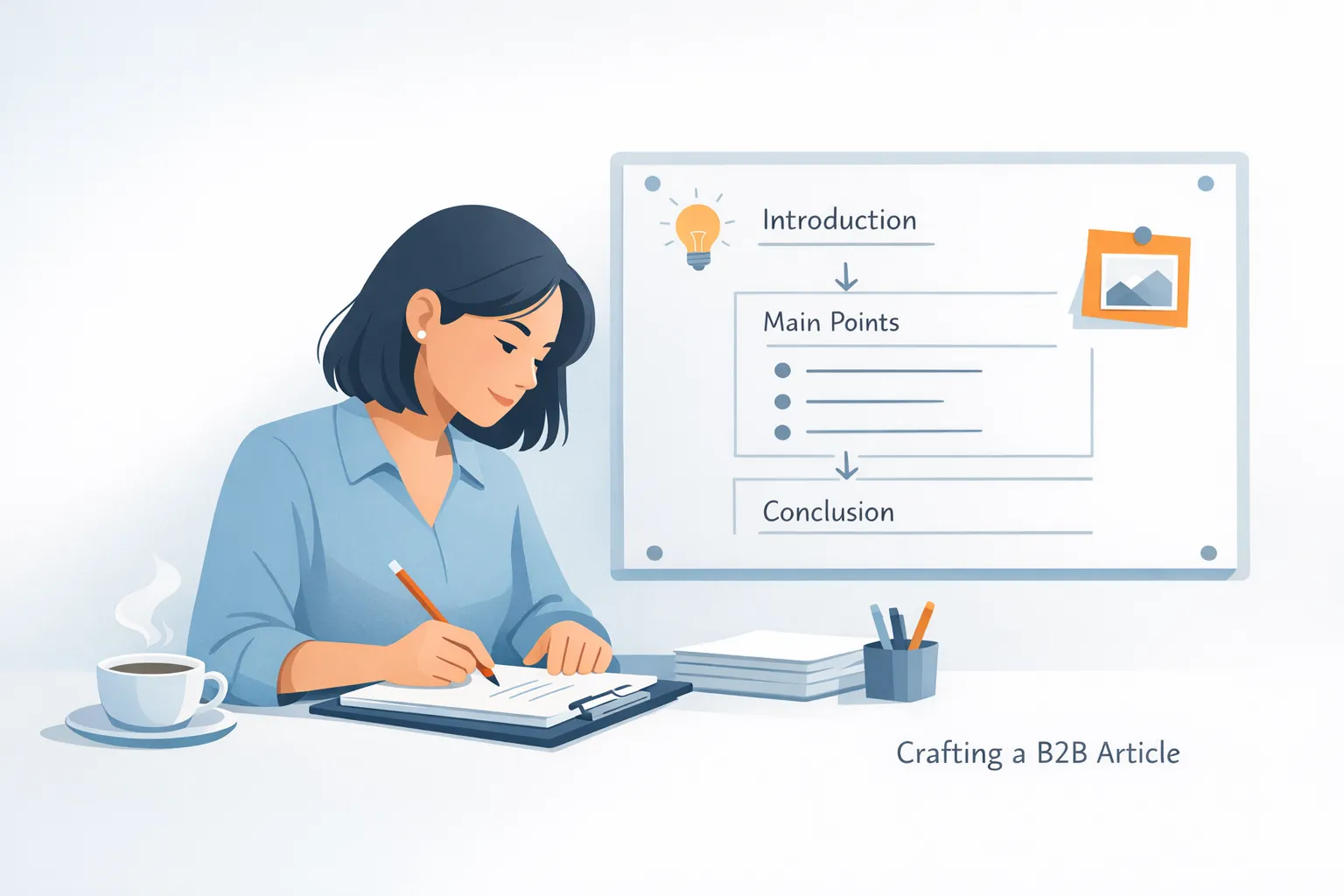
Create a clear structure with an intro, 3 to 5 core sections, and a conclusion. Use descriptive headings to guide scanning. Plan to front load key insights in the early sections.
How to verify: Outline includes defined sections and skimmable structure.
Common fail: Dense walls of text without headings.
-
Draft to target length
Write to the length target while keeping clarity and value. Ensure each section delivers a concrete takeaway. Avoid filler and repetition.
How to verify: Draft reaches the target length while preserving value.
Common fail: Padding to hit word count.
-
Incorporate visuals and real world examples
Add visuals that support each major point. Include quotes or case studies to illustrate claims. Ensure visuals are integrated into the narrative rather than added on.
How to verify: Visuals are present and connected to the text.
Common fail: Visuals are irrelevant or missing.
-
Optimize readability and SEO
Review for scannability with short paragraphs bullets subheads. Use natural keyword usage and ensure internal and external links are placed. Adjust structure if any section feels redundant.
How to verify: Readability and SEO checks pass.
Common fail: Overstuffing keywords or poor structure.
-
Plan distribution and repurposing
Map distribution across channels and set cadence. Identify formats for repurposing the core content into shorter updates and social posts. Prepare teaser hooks and repurposing calendar.
How to verify: Distribution plan exists and is scheduled.
Common fail: No distribution plan.
Verification plan for mid length B2B articles
To confirm success you will check that the piece fits the 1 200 to 1 600 word range aligns with a real audience need and presents credible data within a clear readable structure. You will also verify a plan for visuals internal and external links and distribution. This ensures stakeholders understand the value depth and readability while enabling reuse across channels and ecosystems.
- Topic and length alignment with audience needs
- Credible data or quotes included
- Skimmable structure with headings and bullets
- At least one supporting visual
- Internal and external linking plan
- Repurposing plan defined
- Distribution plan scheduled
- Word count within 1200 to 1600
- Editorial sign-off completed
- Brand voice and readability verified
- Defined performance metrics
- Stakeholder approval obtained
| Checkpoint | What good looks like | How to test | If it fails, try |
|---|---|---|---|
| Topic alignment | Mid-length depth is clearly required by the topic and audience | Review outline and audience brief | Re-scope the topic or adjust the length target |
| Data credibility | Data and quotes are credible and properly attributed | Check sources and citations | Replace weak data with credible sources |
| Structure clarity | Headings bullets and callouts guide scanning | Readability check and skim test | Add subheads tighten paragraphs |
| Word count target | Drafted within 1200 to 1600 words | Word count tool | Trim filler or expand sections to hit target |
| Visuals | At least one relevant visual supports key points | Visuals verified against text | Add infographic or image or adjust alignment |
| Links | Internal and external links present and relevant | Link audit and anchor text review | Add missing links or replace non-relevant ones |
Troubleshooting mid length B2B articles
This section spots common blockers that keep a 1200 to 1600 word piece from delivering depth readability and measurable impact. Use these fixes to quickly recalibrate structure data and distribution and to ensure the content remains practical and actionable for a B2B audience.
-
Symptom: Word count drifts below the 1200 threshold.
Why it happens: The outline lacks depth or required sections are missing, leading to concise drafting.
Fix: Expand each core section add a data point or example and insert a brief conclusion that restates the primary takeaway.
-
Symptom: Topic depth does not justify length.
Why it happens: The topic is addressed too superficially or without concrete problem framing.
Fix: Add a problem statement a step by step approach a comparison or a case study to deepen the discussion.
-
Symptom: Credible data or quotes are missing.
Why it happens: Research was incomplete or sources were not identified.
Fix: Incorporate at least one credible statistic or quote from an industry source and attribute it clearly.
-
Symptom: Dense copy with few subheads.
Why it happens: The draft relies on long blocks of text without scanning aids.
Fix: Break content with descriptive subheads insert bullet lists and include short summaries after each section.
-
Symptom: Visuals not aligned with key points.
Why it happens: Images charts or quotes are present but not connected to the narrative.
Fix: Pair each visual with a caption tie it directly to a point and ensure it reinforces the takeaway.
-
Symptom: Internal external links missing or poorly chosen.
Why it happens: Linking plan was not executed during drafting or links were added haphazardly.
Fix: Add relevant internal links to related content and reference trusted external sources where appropriate.
-
Symptom: No clear distribution repurposing plan.
Why it happens: Publication strategy was not defined leaving the piece with limited reach.
Fix: Create a micro content plan including blog posts social snippets and an email tease and schedule the cadence.
-
Symptom: Readability checks fail.
Why it happens: The piece uses jargon heavy language or inconsistent tone.
Fix: Simplify language normalize terminology align with brand voice and run a quick readability pass.
People ask next about mid length B2B articles
- What is the recommended length for mid length B2B articles? The recommended length range is 1200 to 1600 words to balance depth with readability; adjust within that band based on topic complexity and audience needs.
- How do I decide if a topic needs 1200–1600 words rather than shorter or longer? Evaluate topic complexity and the level of guidance readers need. If the topic benefits from data backed claims, step by step instructions, or comparisons, mid length is appropriate.
- What elements justify this length? A clear problem framing credible data or quotes structured sections and actionable insights all support depth without filler.
- How should I structure a mid length piece for readability? Use a logical outline with sections and subheads bullets and short paragraphs front load key takeaways and include visuals or callouts where relevant.
- What data sources should I include Include credible data or quotes from industry sources and attribute them clearly to boost authority, inline with your topic.
- How can I repurpose mid length content across channels? Break the piece into micro content such as blog posts emails social updates and visuals and adapt formats for each platform.
- What metrics indicate success for mid length B2B articles? Track engagement time shares inbound links and conversions along with organic visibility to gauge impact.
- What common mistakes should I avoid? Avoid filler content overstuffing with keywords and skipping a proper outline avoid dense blocks and neglecting a distribution plan.
Common questions about mid length B2B articles
-
What is the ideal word count for mid-length B2B articles?
An ideal mid-length B2B article falls between 1,200 and 1,600 words. This range provides enough room to articulate a clear problem, present data-backed reasoning, and include practical steps or comparisons without overwhelming readers. It supports comprehensive coverage while maintaining readability for busy professionals. When topic complexity dictates more depth, extend toward the upper end; for straightforward issues, aim closer to the lower bound.
-
How do I decide when to use 1200–1600 words instead of shorter or longer?
Start by evaluating topic complexity and the guidance readers need. If your topic requires data backed claims, step by step instructions, or a compare/contrast, mid-length is appropriate. Consider audience attention spans and distribution goals; if stakeholders expect depth but not full long-form exploration, aim for the 1,200 to 1,600 word window. Use benchmarks from credible sources to validate the choice and adjust within the range as needed.
-
What elements justify this length?
Key elements include a clear problem framing, credible data or quotes, structured sections, and actionable insights. A mid-length piece should balance depth with brevity by front-loading the most important takeaways, using subheads and visuals to aid scanning, and including a comparison or checklist where relevant. The goal is to deliver real value without filler, so every paragraph advances the decision or learning.
-
How should I structure a mid-length piece for readability?
Structure is essential for readability. Use a clear outline with sections and subheads, brief paragraphs, and bullet lists where helpful. Front-load the problem statement and the key takeaway in the opening. Use a mid-length narrative arc that walks readers through context, evidence, and recommended actions, followed by a concise conclusion. Include at least one visual or callout that reinforces the primary insight and helps readers skim for the core message.
-
What data sources should I include?
Incorporate credible data or quotes from industry sources to boost authority. Prefer recent benchmarks, surveys, or case studies relevant to the topic. Attribute every statistic or claim clearly and link to sources in the hub when possible. If original research is unavailable, cite established reports and provide context. The aim is to strengthen trust and provide readers with verifiable takeaways they can apply, not just assertions.
-
How can I repurpose mid-length content across channels?
Identify core insights and convert them into micro-content such as blog posts, emails, or social updates. Create a content hub anchor and plan a calendar for repurposing. Adapt formats to each channel while preserving the key takeaways and data points. This approach extends reach without duplicating effort.