To build a topical map from SERP patterns you will start by capturing the SERP signals that signal intent, patterns, and feature presence, then group related queries into clusters by user goal. The simplest path is a five step workflow: identify a core topic, extract SERP clusters by intent, define pillar pages and supporting topics, assemble a visual topology that shows parent-child links, and finally validate the map against live SERP results to tune priorities and internal links. Along the way you will prioritize topics with the strongest alignment to audience needs, map clusters to concrete content ideas, and plan an execution calendar that emphasizes depth on pillar pages before fleshing out subtopics. This approach keeps your map actionable, repeatable, and scalable so you can refresh it as SERP patterns evolve and search dynamics shift.
This is for you if:
- You are an SEO strategist or content lead building topical authority from SERP data
- You need a data driven, repeatable workflow to plan pillar and cluster content
- Your team relies on clear internal linking to connect topics and boost authority
- You want to adapt quickly to SERP shifts without reworking the entire plan
- You seek a scalable framework that guides content creation and measurement
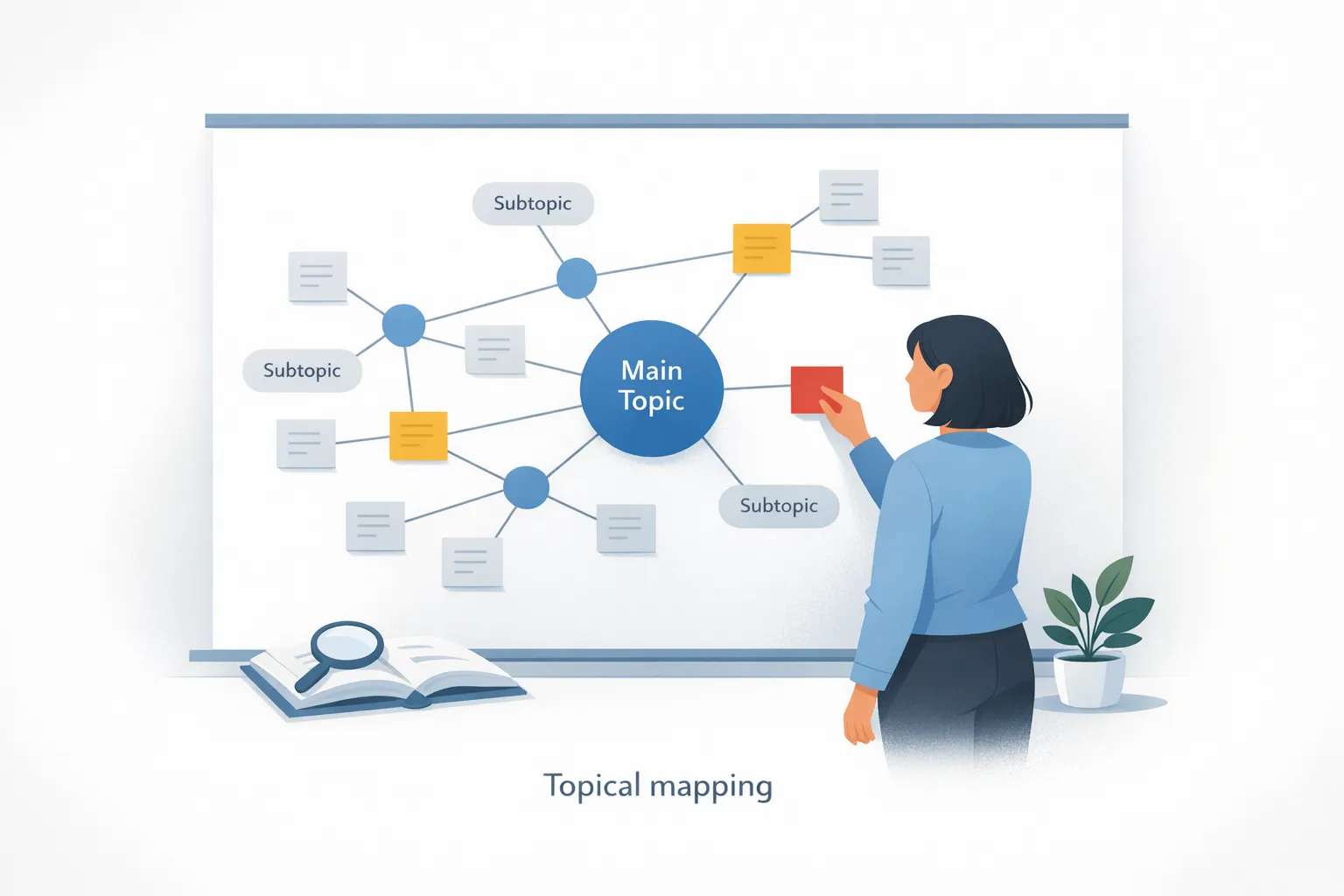
Prerequisites for Building a Topical Map from SERP Patterns
Prerequisites matter because a solid map starts from the right data and a shared plan. Having access to SERP signals, a clear topic focus, and a collaborative workflow ensures you can identify gaps early, group queries by intent, and build a scalable architecture you can grow over time. With these foundations, you can move quickly from data collection to a repeatable mapping process and keep the map aligned with real search patterns.
Before you start, make sure you have:
- Access to SERP data and a toolset for pattern analysis
- A clear core topic or domain to map
- Defined target audience and intent signals
- Ability to perform competitive analysis and gap identification
- Collaboration across content SEO and web teams
- A plan or template for mapping pillar pages and clusters
- A process to collect and organize SERP signals
- Access to a SERP analysis tool such as SERPrecon
- Keyword research tools including Ahrefs, Semrush, and Google Search Console
- Mind mapping or visualization tools for topology
- A template for topical authority map
- A plan to set up internal linking between pillars and clusters
- A calendar or workflow to execute the mapping
- Ability to validate the map with live SERP data
- Clear success metrics and review cadence
- Understanding of content governance and version control
Take Action Now: Build a Topical Map from SERP Patterns
Set expectations and pace. You will gather signals, cluster queries by intent, and translate findings into a navigable topology of pillars and clusters. The process emphasizes starting with a clear core topic, validating clusters against real search results, and iterating as SERP patterns evolve. Focus on actionable steps, keep the map readable for stakeholders, and build in a practical content plan that can scale over time. This approach helps you stay aligned with user needs and search engine expectations without overhauling your site.
-
Identify SERP signals
Identify the signals that indicate intent and SERP structure. Catalog the presence of featured snippets, People Also Ask, long-tail patterns, and topic authority indicators. Note which signals appear consistently across the top results and which suggest deeper topical depth. Use these signals to steer how you group queries into clusters. Tools like SERPrecon can identify gaps and patterns you might miss. Source
How to verify: Signals are clearly defined and mapped to clustering rules.
Common fail: Ambiguity about which signals matter leads to vague clusters.
-
Gather SERP data
Pull rankings, features, and related queries for the topic from your chosen tools and compile a data set you can trust.
How to verify: Data covers multiple top results and includes at least one SERP feature tag per result.
Common fail: Using a narrow slice of results or outdated data.
-
Cluster by intent and similarity
Group queries into clusters based on user intent and semantic similarity, creating coherent topic groups that map to pillars and clusters. Ensure every cluster has a clear intent label and multiple related queries. This structure improves navigation and topic depth. Source
How to verify: Each cluster has a clear intent label and multiple related queries.
Common fail: Overlapping clusters or mixed intents blur topic clarity.
-
Define pillars and clusters
Determine pillar pages that cover broad topics and assign subtopics as cluster content, ensuring each cluster supports a pillar.
How to verify: Pillars have at least two related clusters and explicit rationale.
Common fail: Pillars with insufficient coverage or poorly defined subtopics.
-
Map clusters into a topology
Create a visual topology that links each pillar to its clusters and shows parent-child relationships to guide navigation and internal linking.
How to verify: A readable topology diagram exists with clear connections.
Common fail: Broken links in the topology or missing cross-links between clusters.
-
Prioritize topics
Rank topics by relevance to the audience and search demand, and set realistic production priorities for pillars and clusters.
How to verify: A prioritized list aligns with business goals and available resources.
Common fail: Priorities misaligned with capacity or audience needs.
-
Develop execution plan
Translate the map into a practical content plan, assigning owners, timelines, and delivery formats for pillar and cluster content. Source
How to verify: A living content calendar exists with clear owners and milestones.
Common fail: Vague ownership or missing deadlines.
-
Validate and adjust
Compare the planned content against live SERP results and performance data, then refine clusters and pillars as patterns shift.
How to verify: Post-implementation metrics show improved relevance and navigation.
Common fail: Stagnation and unupdated maps despite changes in SERP features .
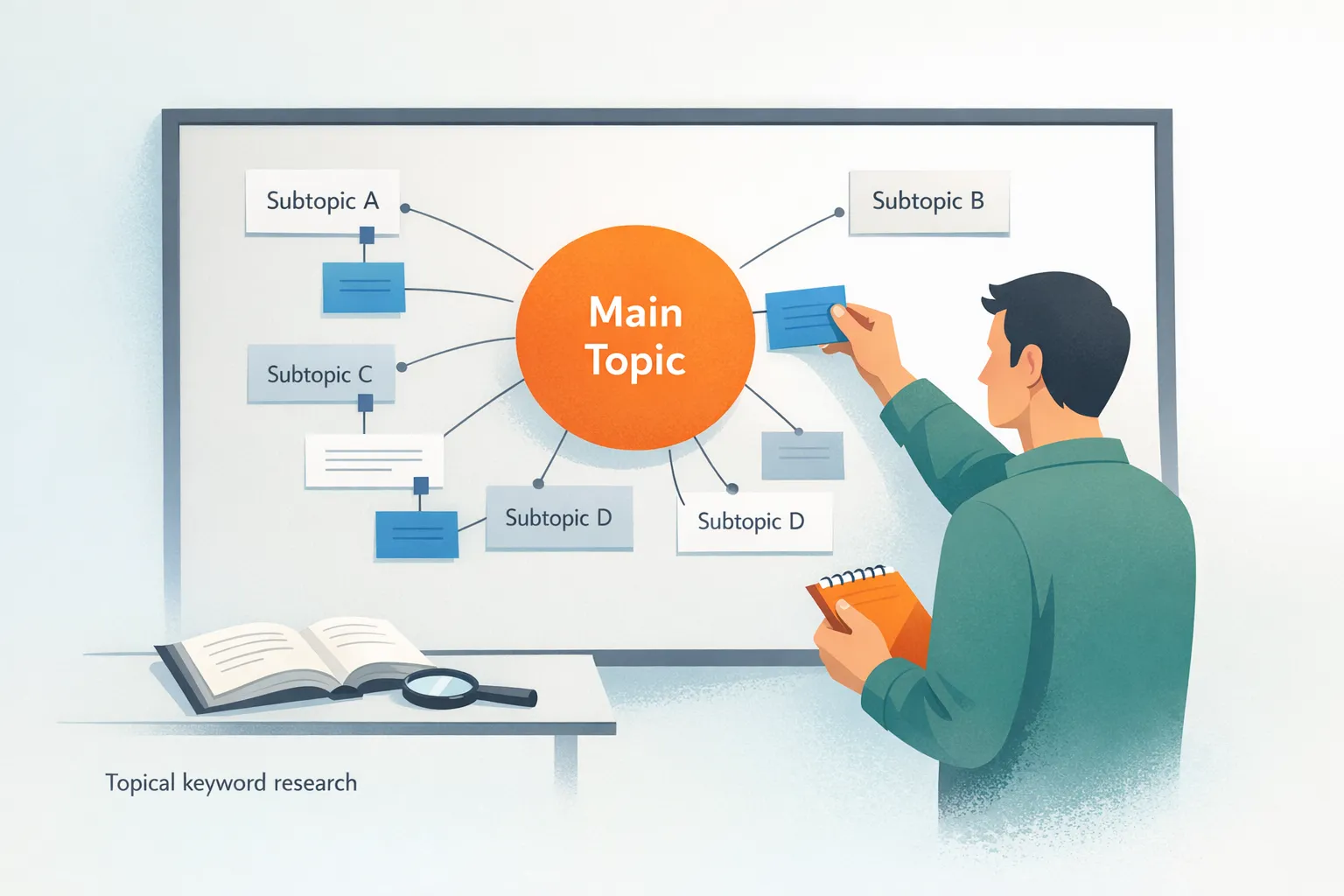
Verification Focused: Confirm the Topical Map Reflects Real SERP Patterns
Verification hinges on comparing predicted topic clusters to live SERP results, validating the pillar to cluster relationships, and confirming the execution plan produces measurable movement in relevance and navigation. You should review the map for completeness, test internal linking paths, and ensure the plan remains current as SERP patterns shift. Use a data driven cadence to revalidate signals and adjustments; tools like SERPrecon can help validate patterns Source .
- Signals consistently tracked
- Clusters align with intent
- Pillars connected to clusters
- Internal links navigable
- Topology readable by stakeholders
- Priorities reflect needs and capability
- Execution plan is actionable
- Live SERP data confirms improvements
| Checkpoint | What good looks like | How to test | If it fails, try |
|---|---|---|---|
| Define and document SERP signals | Signals clearly defined and mapped to clustering rules | Compare signal list to clustering behavior | Review data sources and refine signals |
| Gather SERP data for the topic | Data covers top results and includes SERP feature tags | Cross verify across tools | Use broader data sources |
| Cluster by intent and similarity | Clusters labeled with intent and multiple related queries | Inspect clusters for overlap | Refine intent labels and merge duplicates |
| Define pillars and clusters | Pillars with defined, supported clusters and rationale | Check coverage matrix | Add missing clusters |
| Map clusters into a topology | Topology shows parent-child links and navigable paths | Navigate the topology to find dead ends | Add cross-links |
| Validate and adjust | Plan validated against live SERP data and performance | Compare before/after metrics | Update map and repeat |
Troubleshooting the Topical Map from SERP Patterns
Troubleshooting ensures the map stays accurate as search behavior shifts. By identifying and resolving misalignments quickly you preserve clear intents, robust pillars, and a navigable topology. Work with your team to audit data sources, verify internal links, and refresh priorities so the map remains practical and scalable as SERP patterns evolve.
-
Symptom:
Clusters overlap or mix intents
Why it happens: Labels are unclear and topics gather multiple user goals in one cluster.
Fix: Re-label clusters with explicit intent tags and split overlapping topics; ensure each cluster carries a single clear intent. Validate patterns with SERPrecon Source .
-
Symptom:
Pillars lack sufficient coverage
Why it happens: Not enough subtopics were mapped to each pillar.
Fix: Add at least two relevant subtopics per pillar derived from SERP signals and gap analysis; document the rationale for each addition.
-
Symptom:
Internal linking gaps create orphan pages
Why it happens: Missing connections between pillars and clusters or between related clusters.
Fix: Audit links from every pillar to its clusters and add cross-links between related clusters; verify navigational paths.
-
Symptom:
Data drift across tools
Why it happens: Data from different tools becomes stale or inconsistent.
Fix: Refresh SERP data across tools, timestamp the results, and update cluster assignments accordingly; establish a quarterly refresh cadence.
-
Symptom:
Visual topology is hard to read
Why it happens: The diagram is overly complex or lacks a legend.
Fix: Simplify the topology to essential parent-child connections and add a legend or one-page summary for quick reference.
-
Symptom:
No ownership causing delays
Why it happens: Roles and responsibilities are not clearly assigned.
Fix: Assign owners, define milestones, and attach tasks to a shared calendar or workflow to ensure accountability.
-
Symptom:
Keyword cannibalization risk exists
Why it happens: Same keywords target multiple pages within the map.
Fix: Reallocate keywords so each pillar or cluster has a unique target, and adjust on-page copy to reinforce distinct intents.
-
Symptom:
Gaps not identified due to weak competitor analysis
Why it happens: Competitor coverage is not comprehensively analyzed.
Fix: Expand competitive review to capture top topics and subtopics, then incorporate new gaps into the map Source .
| Symptom | Potential root cause | Action | Measurement |
|---|---|---|---|
| Clusters overlap or mix intents | |||
| Pillars lack sufficient coverage | |||
| Internal linking gaps | |||
| Data drift across tools | |||
| Topology hard to read | |||
| No ownership causing delays | |||
| Cannibalization risk | |||
| Weak competitor analysis |
Common questions you might ask next
- What is a topical map and how does SERP pattern data improve it? A topical map organizes content around core topics and supporting subtopics, showing how pages relate. SERP pattern data reveals how users search and which features appear, guiding topic clustering by intent and boosting coverage and depth.
- How do you identify SERP signals to use for clustering? Start with signals that indicate intent such as features and People Also Ask, then track these across the top results to shape how you group queries into coherent clusters.
- How many pillar pages should a topical map include? Choose a practical set of pillars that reflect your main offerings and allow depth through multiple clusters without sprawling into irrelevance.
- How can you validate a topical map against live SERP results? Compare cluster topics to ranking signals, identify coverage gaps, and monitor how content updates affect visibility and click-through rates.
- What tools are essential for SERP pattern analysis? Use a mix of SERP analysis tools, keyword research platforms, and visualization software to collect signals, organize clusters, and map relationships.
- How should you structure pillar pages and cluster content? Build comprehensive pillar pages that cover broad themes and pair them with focused cluster articles that answer specific questions and link back to the pillar.
- How often should you refresh or update a topical map? Schedule regular reviews to refresh data, re-evaluate clusters, and adjust the topology as SERP patterns shift.
- What common mistakes should you avoid when building topical maps ? Avoid relying on a single data source, mislabeling intents, creating weak internal links, and ignoring ongoing validation.
Practical questions you might ask next about building a topical map from SERP patterns
What is a topical map and how does SERP pattern data improve it?
A topical map is a structured plan that groups related content around core pillars and supporting subtopics. SERP pattern data improves it by revealing how users search, which features appear, and where depth is needed. By tracking signals such as featured snippets, People Also Ask, and long tail queries, you shape topics to match intent and build thorough coverage across a site. Tools like SERPrecon help surface gaps.
How do you identify SERP signals to guide clustering?
Identify signals that indicate intent such as search features, questions, and query variety, then track these across the top results. Map each signal to clusters that reflect user goals, ensuring each cluster represents a coherent topic area. This approach reduces fragmentation and clarifies navigation within the topical map, helping teammates understand why content belongs where.
How many pillar pages should you start with and why?
Start with a practical number of pillar pages that align with your main offerings and allow depth through multiple clusters. Pillars should be broad enough to support several related subtopics while staying focused enough to avoid scope creep. The goal is a scalable core you can grow over time as SERP patterns shift and new opportunities emerge.
How can you validate a topical map against live SERP results?
Validation comes from comparing cluster topics to live SERP signals, looking for alignment and coverage gaps, and monitoring how content updates influence visibility and click through rates. Use historical data as a baseline, then recheck after major content changes. Continuous validation keeps the map relevant as search patterns evolve.
What tools are essential for SERP pattern analysis?
Essentials include SERP pattern analysis software, keyword research platforms, and visualization tools to map signals to clusters. A balanced toolkit helps you capture features, intent cues, and query variations while you arrange topics into pillar and cluster structures. Regular practice with these tools builds a repeatable process and keeps the map aligned with real search behavior.
How should you structure pillar pages and cluster content?
Structure pillars as comprehensive guides and anchor pages; attach clusters as in depth articles that answer specific questions. Link from clusters back to the pillar and create cross links between related clusters to reinforce topic depth and ease navigation for users and crawlers.
How often should you refresh the topical map to stay current?
Refresh the topical map with a regular cadence that reflects shifts in SERP features and user intent. Reevaluate clusters, update pillar coverage, and adjust internal links to preserve navigability and topical authority. Treat the map as a living document that evolves with your audience and search engines, not a one off exercise.