To build a 12 week SEO driven content plan you start with a clear business goal and a quick data baseline, then translate that into a practical weekly roadmap. You will map keywords to topic clusters, define pillar pages and supporting content, and fix critical technical issues that block visibility. The simplest correct path is to establish a lean, sprint based plan: set week by week milestones, assign owners, create briefs, and publish in cadence while tracking key signals like traffic, rankings and conversions. Begin with a quick audit of site health and keyword intent, lock down a 12 week content calendar, and implement a lightweight dashboard to monitor progress. Move in weekly sprints, conduct a mid cycle check, adjust priorities, and scale on success while preserving quality, consistency and alignment with business goals.
This is for you if:
- You own or manage SEO content programs and need a tangible 12 week plan
- You want to translate keyword research into a structured content calendar
- You aim to fix critical technical blockers before scaling
- You require weekly execution cadence with clear owners and briefs
- You need a lightweight dashboard to track traffic rankings and conversions
- You seek alignment between content and business goals for sustainable growth
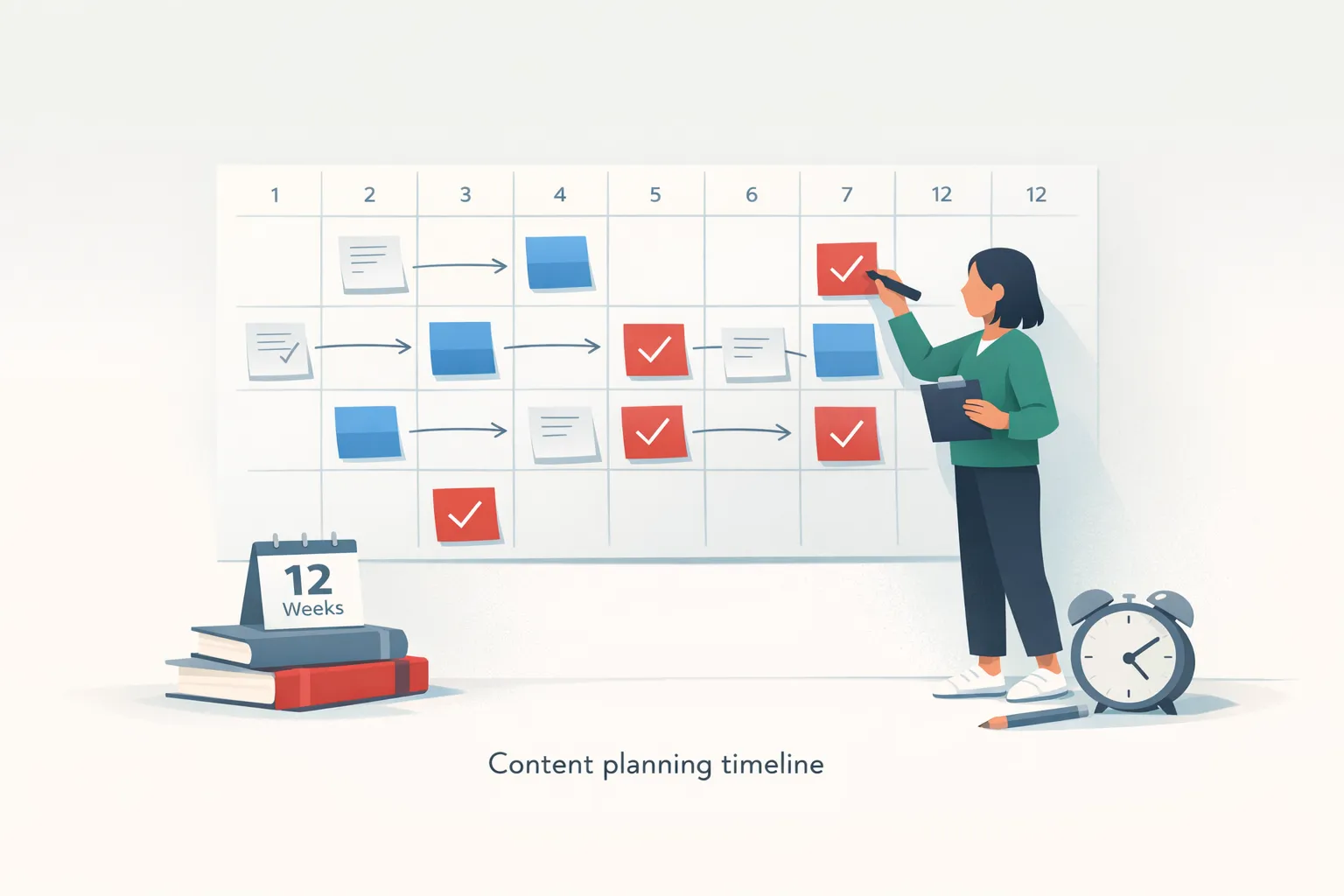
Prerequisites for a 12-Week SEO Content Roadmap
Prerequisites matter because they anchor your 12 week plan in real performance signals, align teams around shared goals, and prevent scope creep. A solid foundation reduces back and forth delays, speeds approvals, and helps forecast ROI as you scale content and optimization efforts.
Before you start, make sure you have:
- Defined business goals and measurable SEO KPIs aligned to funnels
- Access to website analytics and search data (GA4, Google Search Console)
- Baseline metrics for traffic engagement and conversions
- Up-to-date keyword research data or a plan to conduct research
- Editorial calendar and content production capacity
- Content briefs and templates for pillar and cluster content
- CMS access and publishing workflow to implement changes
- Technical audit tools and access for quick site fixes
- Internal linking strategy and pillar cluster plan
- Cross-functional stakeholders and governance in place
- Budget and resources allocated for SEO experimentation
- Clear owners for strategy content and technical tasks
- Templates for dashboards and weekly progress reporting
- Understanding of regional local considerations if relevant
- Reference resources or frameworks for planning such as The Digital Marketing Success Plan
Execute a 12 Week SEO Content Roadmap
This step by step procedure moves you from goals to action within a focused twelve week window. You will align business priorities with SEO metrics map keywords to topics and design pillar pages with supporting clusters. The plan emphasizes weekly sprints clear ownership and practical briefs that keep content technical work and measurement in sync. You will audit your current data define a lean publishing cadence and build a lightweight dashboard to monitor signals like traffic and conversions. By staying tight on scope and prioritizing quality you can deliver sustainable growth while adapting to feedback.
-
Define goals and KPIs (verb-first)
Clarify business aims and select SEO metrics that reflect value to the business. Translate these targets into actionable objectives for the 12 week plan. Document them in a shared plan so every team member follows the same direction.
How to verify: Goals and KPIs are written and accessible.
Common fail: Goals are vague or fail to tie to outcomes.
-
Audit site and data (verb-first)
Review analytics and search console data to establish a baseline of traffic conversions and technical health. Note quick wins and longer term gaps that affect the roadmap. Capture findings in a concise baseline report.
How to verify: Baseline report exists and informs priorities.
Common fail: Skipping the audit or relying on incomplete data.
-
Map keywords to topics and clusters (verb-first)
Group keywords by topic and map them to potential pillar pages and clusters. Ensure each topic aligns with user intent and funnel stage. Create a high level map showing connections between pillars and clusters.
How to verify: Keyword topic map exists and covers core topics.
Common fail: Keywords planned in silos without coherent clusters.
-
Define pillars and supporting clusters (verb-first)
Define pillar topics and supporting clusters that map to the keyword plan. Source Apply START Planning Process to guide the pillar and cluster setup across channels. This provides a structured hierarchy and clear ownership. It helps align content with business priorities and measurable milestones.
How to verify: Pillar and cluster structure is documented with ownership.
Common fail: Pillars and clusters are misaligned with the keyword map.
-
Plan content calendar and briefs (verb-first)
Create a publishing calendar that aligns with pillar topics and clusters. Attach briefs that specify target keywords, intent, format, and write guidelines. Schedule review points and sign offs to maintain consistency.
How to verify: Content calendar and briefs are published and accessible.
Common fail: Briefs missing key requirements or publishing cadence is undefined.
-
Fix technical issues and optimize pages (verb-first)
Run a quick technical sweep targeting speed mobile usability indexing and structured data. Apply fixes to priority pages and verify improvements. Document ongoing technical tasks for the roadmap.
How to verify: Technical issues resolved and pages improve on core metrics.
Common fail: Tech fixes are deferred or incomplete causing friction.
-
Create and publish content cadence (verb-first)
Produce content aligned with briefs and publish on a regular cycle. Maintain quality checks and incorporate feedback from editors. Schedule updates for existing assets when needed.
How to verify: Published content follows the cadence and meets quality standards.
Common fail: Publishing stalls or quality declines under pressure.
-
Build pillar cluster internal links (verb-first)
Establish strong internal links from clusters to their pillar and between related clusters. Audit anchor text and ensure navigational pathways support topical authority. Monitor for keyword cannibalization and adjust as needed.
How to verify: Internal linking reflects the pillar cluster structure.
Common fail: Internal links are sparse or misaligned breaking topical signals.
-
Monitor progress and plan next rollout (verb-first)
Set up dashboards to track key signals like visibility traffic and conversions. Review weekly progress and adjust priorities for the next cycle. Prepare a plan for the subsequent 12 week phase.
How to verify: Weekly dashboards show movement and a clear next step plan is documented.
Common fail: Progress stalls without a revised roadmap.
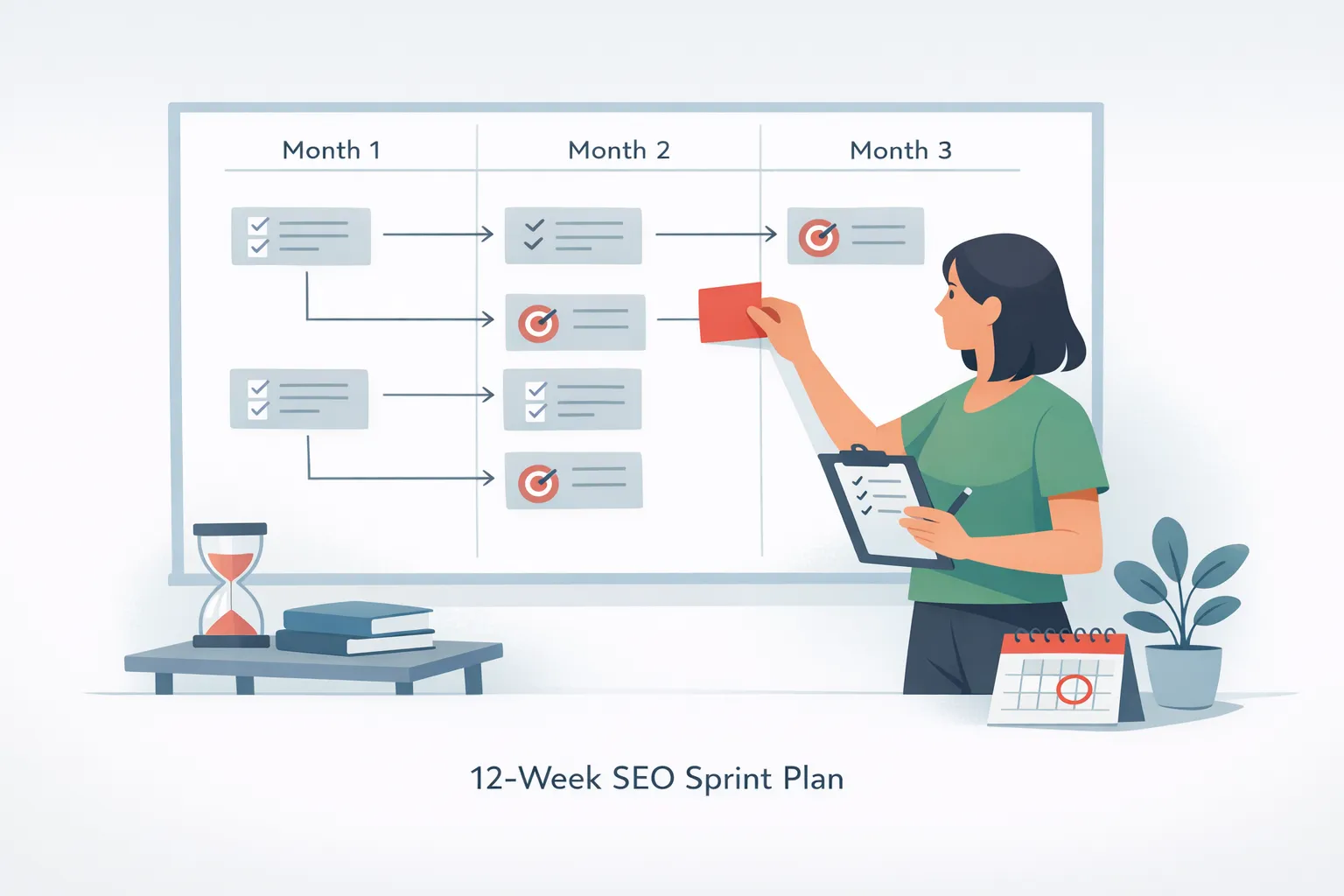
Verification milestones for the 12 week road map
This verification section explains how to confirm success by confirming pillar and cluster deployment, a consistent publishing cadence, and tangible technical improvements. It emphasizes checking dashboards for movement and ensuring stakeholders agree on milestones. The guidance aligns with established planning practices from industry resources to keep the roadmap disciplined yet adaptable. Guidance from The Digital Marketing Success Plan informs the approach. Source
- Pillar pages defined and clusters linked to pillars
- Content briefs created and used for publishing
- Technical fixes completed and core issues addressed
- Internal linking structure matches pillar cluster model
- Dashboards updated with visibility traffic and conversions
- Stakeholders sign off on milestones
- Mid cycle audit completed with action items
- Editorial calendar maintained and used
| Checkpoint | What good looks like | How to test | If it fails, try |
|---|---|---|---|
| Pillar cluster deployment | Pillars exist with clusters connected and internal links in place | Inspect site architecture and run a quick crawl to verify linking | Reorganize content map to ensure correct pillar cluster mapping and reindex pages |
| Cadence established | Publishing calendar is defined and briefs are in use | Review the calendar and confirm briefs are accessible and followed | Reassign owners or adjust cadence to fit capacity |
| Technical fixes verified | Core issues addressed and page performance improves | Run speed tests and indexing reports to confirm improvements | Prioritize fixes on high impact pages and re-test after changes |
| Performance review completed | Traffic and conversions show movement and content plan evolves | Compare analytics dashboards to baseline and review KPI attainment | Reassess topics and KPI targets and adjust the approach |
Troubleshooting Common Blockers in a 12 Week SEO Roadmap
This 50 word paragraph sets expectations for diagnosing and resolving blockers that slow progress on a 12 week SEO roadmap. It emphasizes practical, actionable fixes, using dashboards to verify improvements, and adjusting ownership to keep momentum. The goal is to restore cadence while maintaining quality and alignment with business objectives.
-
Symptom: Publishing cadence slips or delays
Why it happens: Capacity constraints or unclear ownership disrupt scheduled outputs.
Fix: Reconfirm owners, simplify briefs, lock calendar, set micro-deadlines, and create a gated publish process.
-
Symptom: Pillar to cluster linking gaps
Why it happens: Internal linking plan not followed or topics misaligned with clusters.
Fix: Run a linking audit, update anchor text, and ensure every cluster links to its pillar.
-
Symptom: Technical fixes revert or have no effect
Why it happens: Insufficient dev bandwidth or fixes applied to low-impact pages.
Fix: Prioritize fixes by impact, coordinate a sprint with development, and re-test core pages. For structure use START Planning Process. Source
-
Symptom: Keyword cannibalization detected
Why it happens: Multiple pages target the same intent or keyword without differentiation.
Fix: Consolidate pages, set canonical tags, and re-map topics to create distinct pillar and cluster signals.
-
Symptom: Low-quality content despite cadence
Why it happens: Pressure to publish faster than content quality and intent alignment allow.
Fix: Pause new pieces, run quick content audits, tighten briefs, and strengthen editorial review before publishing.
-
Symptom: Localization or geo targeting missing
Why it happens: Regional signals are not integrated into calendars or content briefs.
Fix: Create region specific calendars, add local modifiers, and implement hreflang where appropriate.
-
Symptom: Dashboards show no movement
Why it happens: Tracking gaps or misconfigured metrics obscure progress.
Fix: Verify tracking IDs, align dashboards to objectives, and add KPI baselines for clearer signals.
-
Symptom: Stakeholders drift from plan
Why it happens: Information silos and irregular communication reduce shared ownership.
Fix: Schedule brief weekly updates, publish a single source of truth, and assign clear decision owners.
Common questions about a 12 Week SEO Content Roadmap
- How do I start a 12 week SEO content roadmap? Begin with clear business goals and measurable KPIs, perform a quick site and keyword audit, map keywords to topics, define pillar pages and clusters, create briefs, fix critical technical issues, establish a publishing cadence, and set up a lightweight dashboard to monitor progress.
- What should be in the 12 week calendar? Milestones for pillar pages early on, a plan for cluster articles, publication dates, briefs, internal linking steps, and checks for technical health and dashboard updates.
- What are pillar pages and clusters? Pillar pages are broad topic hubs; cluster articles cover subtopics and link back to the pillar to form a topic authority network.
- How is success measured? Track changes in visibility, organic traffic, engagement, and conversions; monitor keyword rankings and internal link signals; review dashboards weekly and at mid cycle.
- When should technical fixes be done? Address speed, mobile usability, crawlability and structured data early to unlock content performance and indexing.
- How do I avoid scope creep? Define a constrained scope for each sprint, assign owners, and use briefs and governance to prevent drift.
- How do you map keywords to topics? Group keywords by topic, align with user intent and funnel stage, and assign each topic to a pillar or cluster plan.
- What comes after 12 weeks? Review outcomes, refine pillar topics, adjust the roadmap for the next cycle, and scale successful formats and channels including multimedia and links.
Top Questions About Building a 12 Week SEO Roadmap
How should I start the 12-week SEO roadmap?
To start the 12-week SEO roadmap, begin by aligning with business goals and selecting a small set of high-impact KPIs that reflect value to the organization. Conduct a rapid data audit using analytics and search console to establish baselines for traffic, rankings, and conversions. Map keywords to topic clusters, define pillar pages and supporting content, and lock a lean publishing cadence with clear briefs. Keep scope tight and iterate weekly.
What should be in the 12-week calendar?
Your 12-week calendar should include early pillar page launches, a plan for supporting cluster articles, published dates, briefs, internal linking steps, and checks for technical health. Maintain a weekly sprint rhythm, schedule a mid-cycle review, and ensure dashboards capture visibility, traffic and conversions. Build in milestones for review and adjustments as you scale.
What are pillar pages and clusters?
Pillar pages are comprehensive hubs that anchor a topic, while clusters are supporting articles that explore related subtopics and link back to the pillar. This structure signals topical authority to search engines and improves internal navigation. Start by selecting core pillar topics based on audience intent and business priorities and then fill clusters around each pillar.
How is success measured?
Success is measured by progress on key signals that matter to the business: rising visibility, increasing organic traffic, improved engagement metrics, and a growing share of conversions from search. Track keyword movements, monitor internal linking patterns, and verify that dashboards reflect steady movement. Schedule a mid-cycle check to recalibrate targets and tactics based on data.
When should technical fixes be completed?
Technical fixes should be tackled early because they unlock performance for content. Prioritize speed mobile usability crawlability and structured data on high traffic pages and cornerstone assets. After implementing changes re-test with speed tests indexing reports and user experience signals. Maintain a running log of fixes and owners so ongoing optimization remains visible.
How do you map keywords to topics?
Mapping keywords to topics starts by grouping by intent and funnel stage. Assign each topic to a pillar or cluster plan and ensure coverage across subtopics that answer user questions. Create a living map showing connections between pillars and clusters in a living document that you review at weekly cadences.
What comes after 12 weeks?
What happens after 12 weeks is a formal review: assess outcomes against goals refine pillar topics adjust the roadmap and scale winning formats including multimedia and link building. Use the mid-cycle learnings to plan the next six to twelve weeks and continue the cadence with improved efficiency and expanded topic authority.
How can I avoid scope creep?
To avoid scope creep, enforce a fixed sprint scope with clear briefs owners and approvals. Limit the number of active topics each cycle and base decisions on data rather than opinions. Use governance rituals weekly or biweekly and publish a single source of truth so every stakeholder remains aligned.