A small business increased organic traffic by 40% in six months by building and refining a disciplined content cluster. The core idea was to anchor content around a few pillar topics that reflect the business’s services, then publish tightly scoped cluster articles that answer local intents and drive internal links back to the pillar. Key steps included baseline data review (GA4, GSC, GBP), mapping local keyword opportunities, and developing templated briefs with target keywords, internal link plans, and local schema guidelines. Editorial QA ensured E-E-A-T, accuracy, and local relevance, while automation supported drafting and CMS publishing on a steady cadence. Local signals were amplified via GBP updates and consistent NAP placement, with schema for LocalBusiness, FAQ, and events. The team tracked progress through 30/90/180 day checkpoints using a unified dashboard to merge GA4, GSC, and GBP data, measuring sessions, rankings, and local conversions. The result was multiple entry points for long-tail queries, improved local pack visibility, and a clearer path for turning visits into leads.
This is for you if:
- You lead a local service business or small marketing team seeking scalable, repeatable content systems.
- You need measurable local SEO gains (local packs, GBP signals) without a heavy paid media push.
- You want a pillar-cluster workflow with baseline audits, briefs, QA, and CMS publishing.
- You must manage limited resources with a data-driven dashboard (GA4, GSC, GBP) to monitor progress.
- You aim to sustain momentum with governance, edge-case handling, and ongoing optimization.
Length and depth requirement
Word count target
The first third of the article should land around 1100–1300 words. The aim is a thorough examination that lays a solid foundation for the case study while leaving room for deeper analysis in later sections. Precision in the data, clear explanations of the methodology, and concrete milestones will anchor the narrative without drifting into filler.
Depth goals
Explain the underlying logic behind each step, not just the actions taken. Tie decisions to observable signals such as keyword coverage, local intent, and internal linking changes. Highlight why certain design choices matter for local packs, maps visibility, and GBP-driven signals. Include caveats and scenarios where similar tactics might underperform, so the discussion remains practical rather than prescriptive.
Tone and nuance
Maintain a balanced, evidence-based tone. Favor clarity over hype and avoid sweeping generalizations. Emphasize the tradeoffs between speed and quality, automation and editorial judgment, and short-term gains versus long-term authority. Ground assertions in the workflow and measurable outcomes rather than anecdotes alone.
Edge cases and tradeoffs
Address how cadence, content quality, and local data freshness interact with algorithm updates. Discuss when to favor pillar breadth over depth, how to prune aging content, and how to prevent cannibalization across pillar and cluster pages. Acknowledge resource constraints common to small businesses and offer scalable, governance-focused remedies.
Mental model / framework
Pillar-Cluster Content Model
The core idea is to anchor content around a small number of pillar topics that reflect core services, then publish tightly scoped cluster articles that answer specific local intents and link back to the pillar. This structure supports semantic depth, easier indexation of related terms, and clearer navigational paths for readers. These patterns underpin scalable SEO programs and guide content velocity in service areas, improving both topical authority and local visibility. Source A real-world example of this approach is described in a small business case study from Kirna Technologies, illustrating a practical implementation of pillar and cluster design. Source
Internal Linking Authority Model
Internal linking distributes authority across pages and signals topic relationships to search engines. A deliberate linking flow from pillar pages to clusters, and among clusters, helps crawlers discover and contextualize content more efficiently. This enhances indexation speed, reduces orphan pages, and improves user navigation, contributing to more stable rankings over time.
Editorial QA and governance
Human review remains essential to preserve accuracy, local relevance, and E-E-A-T signals. The governance framework should enforce canonicalization, prevent duplicate content, and ensure consistent NAP presentation across pages and GBP listings. A lightweight pre-publish QA checklist helps catch gaps before content goes live and protects against editorial drift as scale increases.
Data-driven iteration and dashboards
A dashboard-centric workflow supports disciplined iteration. Regular reviews of GA4, GSC, GBP, and URL-level performance enable timely adjustments to topic coverage, keyword targets, and internal-linking strategies. The cadence of review—monthly, then quarterly—drives steady gains and reduces the risk of stagnation.
Definitions
Pillar page
A pillar page is a comprehensive hub that broadly covers a core topic and links to related cluster pages that explore subtopics in depth.
Cluster page
Cluster pages address specific subtopics within the pillar’s umbrella, linking back to the pillar and to other clusters to reinforce semantic relationships.
Internal linking
Internal linking is the deliberate placement of links between pages on the same site to signal topical structure, improve crawlability, and guide readers through a conversion path.
Local schema
Local schema encompasses structured data that communicates local business details to search engines, enabling rich results for service areas and maps.
GBP signals
GBP signals are actions and interactions tied to Google Business Profile, such as views, calls, directions, and reservations, which influence local visibility.
NAP consistency
NAP consistency means keeping the name, address, and phone number uniform across pages and GBP listings to support local trust and accuracy.
Step-by-step implementation (ordered steps)
Step 1: Baseline data and gap analysis
Start with a baseline audit of current performance. Pull GA4, GSC, and GBP data to identify which topics and locations drive traffic, where rankings are strongest, and where gaps exist in local keyword coverage. Map these findings to the customer journey, highlighting informational and transactional intents likely to convert in the local context. This step sets the reference point for all subsequent improvements.
Step 2: Topic generation and cluster planning
Generate a focused set of pillar topics aligned with services and service areas. For each pillar, sketch 4–8 cluster topics that address adjacent queries, problems, and comparisons. Prioritize ideas with clear local intent and achievable long-tail coverage, ensuring clusters collectively support the pillar’s authority and user value. Document the intended reader action for each cluster (learn more, compare, or convert).
Step 3: Draft briefs and templates
Create templated briefs that detail target keywords, suggested headlines, meta guidance, internal link plans, and local schema requirements. Include guidelines for NAP presentation and GBP-oriented signals. The briefs should also specify QA checks and pre-publish criteria to maintain consistency and editorial quality across all pieces.
Step 4: AI-assisted drafts with editorial QA
Use AI to generate draft content, then run a human editorial pass focused on accuracy, local relevance, and E-E-A-T signals. Verify local facts, update stock or inventory references, and insert context-specific details like neighborhood names or service-area specifics. The QA pass ensures the draft meets quality standards before publication.
Step 5: Publishing cadence and CMS integration
Publish on a steady cadence and connect the publishing workflow to a calendar within the CMS. Ensure each post includes LocalBusiness, FAQ, or Event schema where appropriate, and place strong internal links to pillars and relevant clusters. Automations should align with the content velocity plan to sustain momentum without sacrificing quality.
Step 6: Technical checks and validation
Before publishing, perform a pre-publish checklist covering mobile readiness, page speed optimization, NAP validation, and schema accuracy. Validate that internal links point to correct pages, avoid canonical conflicts, and confirm that no duplicate content exists across clusters. After publication, monitor for indexing updates and schema validation results.
Step 7: Measure and iterate
Use dashboards to merge GA4, GSC, and GBP data, tracking 30/60/90-day milestones and longer-term trends. Assess whether traffic and local engagement are rising, and whether pillar and cluster pages are achieving their intended intents. Use findings to refine pillar topics, adjust cluster coverage, and optimize internal linking to strengthen the topic ecosystem.
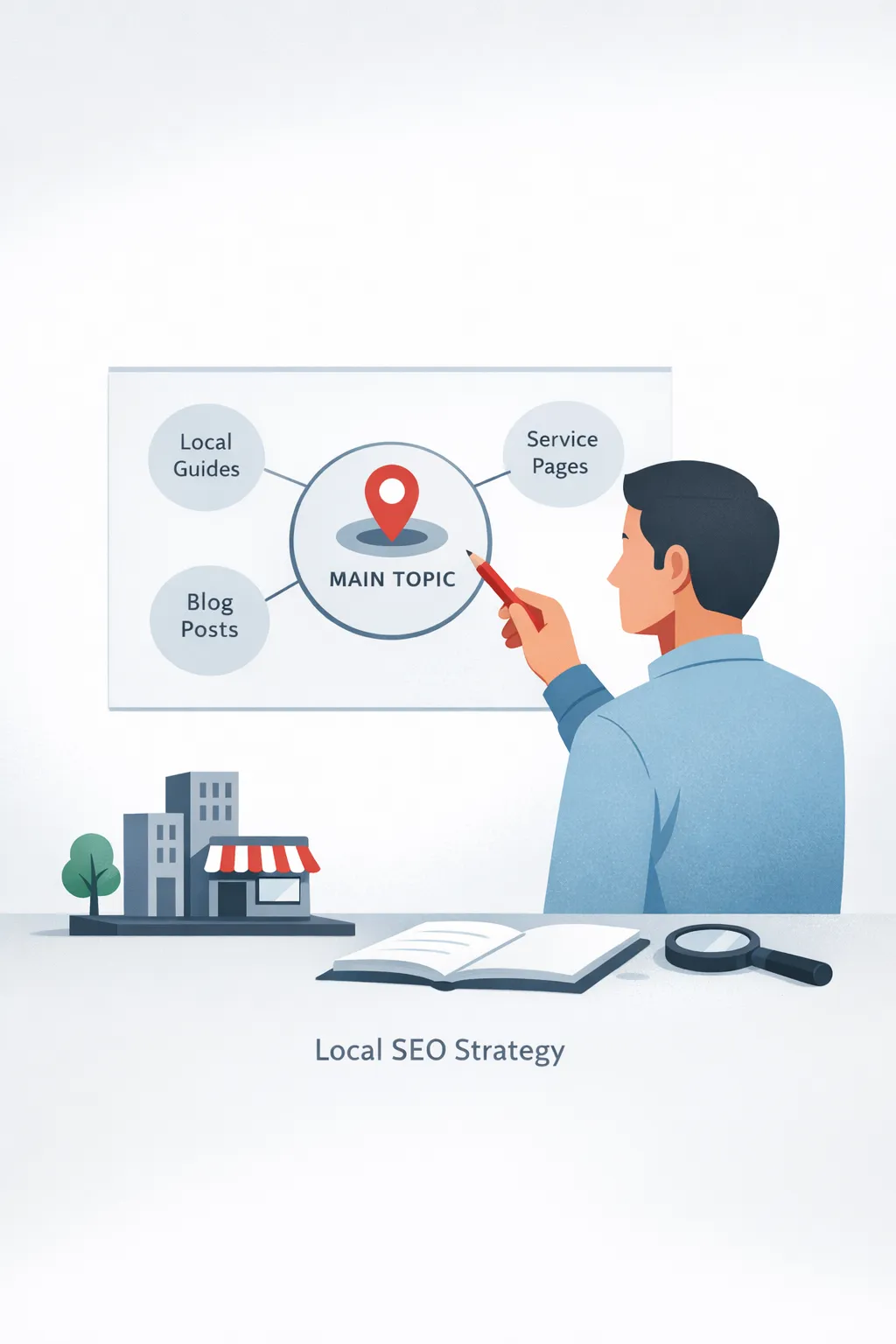
Story structure and intent alignment
A well-told case study hinges on presenting a narrative that mirrors real workstreams rather than a series of isolated tactics. This section expands the framing introduced in the first third by detailing how the problem was defined, what baseline signals showed, and how the team translated those observations into a repeatable content architecture. The narrative moves from a clear problem statement to measurable milestones, then to the design choices that made those milestones attainable. Readers should finish with a concrete sense of how to reproduce the pattern in their own businesses, including the tradeoffs between speed and quality, automation and editorial judgment, and the balance between local signals and broader content authority. The emphasis is on observable processes, not hype, with an emphasis on the causal links between pillar-cluster design, internal linking, and GBP-driven visibility. Source Source
Problem framing starts with identifying a service area where demand is present but organic visibility is limited. In the example underlying this study, a small local business faced stagnant sessions, weak local pack presence, and inconsistent GBP signals despite a reasonable budget for optimization. The baseline data—sessions, key ranking terms, and GBP interactions—guided the selection of pillar topics that could anchor a broader content ecosystem. By tying pillar topics to concrete services and neighborhoods, the team ensured that each cluster could answer highly specific local queries while contributing to a cohesive authority around core offerings. The narrative then follows a logical arc: from audit to design, then to production, governance, measurement, and iteration. The goal is not to present a single “hack” but a replicable framework that can be scaled across locations and service lines.
The topology of success rests on three pillars. First, a structured pillar-cluster model that concentrates topical authority and creates logical paths for readers and search engines. Second, a deliberate internal linking flow that distributes authority, minimizes orphan pages, and accelerates indexation. Third, governance and QA that maintain accuracy, local relevance, and E-E-A-T signals, even as content velocity increases. These elements are not mutually exclusive; they reinforce one another, creating compound effects over time. The outcome is a more navigable site, better coverage of long-tail local terms, and stronger GBP signals driven by richer, more relevant content.
In the practical rhythm of the program, the team mapped baseline performance to a calendar-driven publishing cadence. Monthly reviews surfaced gaps in keyword coverage and local intent, which then fed the next wave of pillar and cluster topics. The cycle emphasizes rapid production without sacrificing quality: templated briefs guide AI-assisted drafting, but every draft passes through editorial QA to preserve accuracy, local nuance, and trust signals. This approach aligns with the broader literature on content velocity and topical authority, which argues that consistent cadence and structured topic coverage yield durable gains in organic visibility. Source
Finally, the narrative foregrounds the experimentation rhythm. Each milestone point—30 days, 90 days, 180 days—acts as a checkpoint for validating signals such as keyword coverage expansion, improved local pack visibility, and GBP engagement. When a milestone is met, the team reinvests in the approach with refined pillar topics, updated cluster coverage, and enhanced internal linking, creating a virtuous loop that sustains momentum. The result is a credible, scalable blueprint for small businesses that want to grow organic traffic by building a content cluster architecture without relying on paid media.
Content design and pillar-cluster specifics
Pillar topic selection and mapping to services
The pillar topics should reflect core services and the neighborhoods or service areas that matter most to the business. Each pillar becomes a hub for related clusters that address common local intents, such as service comparisons, how-to guides, and neighborhood-specific FAQs. The process starts with keyword discovery focused on local intent and feasibility, then tests how well clusters can be mapped to explicit reader actions—learn more, compare options, or book a service. This mapping supports a semantic ladder that helps search engines understand the topic space and guides users toward conversion moments within GBP-enabled signals. Source
Cluster topics and example mappings
For a hypothetical local service business, a set of pillars might include Plumbing Services, Emergency Repairs, and Home Maintenance. Clusters under Plumbing Services could cover topics like “how to diagnose a burst pipe,” “water heater maintenance,” and “choosing a licensed plumber in [city].” Each cluster links back to its pillar and to other clusters where relevant, creating a dense mesh of related content that strengthens topical authority and supports long-tail discovery. The cluster topics should explicitly align with reader intent at different stages of the journey and include practical local details such as neighborhood names, commonly asked questions, and seasonal considerations. The design should anticipate the needs of GBP signals, including calls, directions, and appointment requests, and should incorporate local schema elements to surface rich results in local packs. Source
Content types and multi-format strategy
Beyond traditional blog posts, the design anticipates the inclusion of long-form guides, comparison tables, checklists, FAQs, and service area pages. Diversifying formats helps capture a wider range of user preferences and enhances dwell time, while internal links reinforce the pillar’s authority. The content library should be planned in a way that enables easy updates and re-publication as local signals change, such as inventory status, service area expansions, or promotions. An emphasis on evergreen value with seasonal refreshes can sustain momentum without constant new topic creation.
Internal linking and navigation
Internal linking is the connective tissue that binds pillar and clusters into a coherent ecosystem. A deliberate linking flow from the pillar to clusters, and among clusters, improves crawlability and signals topical relationships. The linking strategy should consider anchor text that reflects reader intent and avoids cannibalization by distributing links across relevant pages. A well-planned structure reduces orphan content, accelerates indexation, and supports a more stable ranking profile as the site grows.
Local signals and schema alignment
Local signals culminate in GBP interactions, map visibility, and local packs. The design embeds LocalBusiness schema on core service pages, uses FAQ and Event schema where appropriate, and maintains consistent NAP across pages and GBP listings. Regular updates to GBP with calls, directions, and availability reinforce signals that Google uses to surface local results. The schema footprint must remain accurate and aligned with on-page content to avoid signal misalignment that could confuse search engines.
Governance and QA integration into design
The design embeds editorial QA into every stage, from briefs to post-publish reviews. Canonicalization, duplication checks, and NAP validation are explicit QA requirements, and a lightweight pre-publish checklist helps maintain consistency as velocity increases. Governance also defines ownership for pillar pages and clusters, lays out update cadences, and ensures that data sources used for local signals remain current.
Workflow expansion: cadence, automation, and governance
Cadence plan and calendar
The cadence supports a sustainable velocity: publish 2–4 cluster posts per pillar per month, with one pillar page refreshed quarterly. The calendar aligns with local promotions, seasonal service needs, and GBP events. Each publish follows the templated briefs, AI-assisted drafting with QA, and a pre-publish validation, including LocalBusiness schema and NAP checks. This rhythm balances speed and quality, enabling steady growth without overwhelming the editorial team.
Automation and human touchpoints
Automation accelerates drafting and CMS publishing, but editorial judgment remains essential for accuracy, local relevance, and E-E-A-T signals. AI-generated drafts are filtered through a QA pass that verifies local terminology, neighborhood names, and service-area specifics. The workflow integrates local schema application, internal-linking checks, and GBP-aligned signals to ensure consistent local presence across pages.
Editorial QA specifics
QA covers factual accuracy, local relevance, and canonical integrity. It includes cross-checks against GBP data (for consistency of address and contact details), validation of internal links to pillar pages, and verification of image and data accuracy in tables or charts. The aim is to prevent content that could mislead readers or misrepresent local availability while still moving quickly through the production queue.
Content production types and templates
Templates guide headline structure, meta templates, and local schema variants. Each draft includes a set of recommended internal links, a defined set of target keywords, and a local intent taxonomy. The templates also specify a pre-publish checklist that covers readability, mobile optimization, image alt text, and schema integrity.
Dashboard and verification approach
30/60/90/180-day milestones
The verification plan uses a staged milestone approach to assess progress and recalibrate. At 30 days, the focus is on content velocity and early signals of intent alignment. At 90 days, examine keyword coverage expansion, cluster depth, and GBP engagement. By 180 days, assess local-pack visibility changes, overall organic sessions, and conversion signals. Dashboards should merge GA4, GSC, and GBP data to produce a single view of performance.
KPIs and dashboard configuration
Key metrics include sessions, engaged sessions, keyword rankings, local impressions, and GBP actions (calls, directions, reservations). Dashboards should offer segmentable views by pillar and by location, enabling comparisons across service areas. The Looker Studio or equivalent visualization layer should support filters for timeline, pillar, cluster, and geographic area to reveal compound effects from the content cluster program.
Data sources and governance signals
Maintaining data integrity requires consistent tagging, UTM discipline where applicable, and alignment between on-page schema and GBP signals. Governance processes ensure that updates to pillar or cluster content are reflected across the site and GBP entries, avoiding drift between engine signals and user-facing content. Source
Table: cluster implementation decision checklist
Use this table during planning and reviews to ensure each cluster is well formed before production.
| Decision Area | Critical Question | Yes / No Indicator | Notes |
|---|---|---|---|
| Pillar topic clarity | Does the pillar topic map clearly to a core customer need? | ||
| Cluster breadth | Do clusters collectively cover the pillar topic without gaps? | ||
| Keyword mapping | Are keywords assigned to a single page with defined intent? | ||
| Internal linking plan | Is there a documented linking flow from pillar to clusters? | ||
| Local schema | Will local schema types be present on the relevant pages? | ||
| NAP consistency | Is name, address, and phone consistent across pages and GBP? |
Follow-up questions block
- What is the quickest way to start a pillar and cluster program for a small business?
- How do I choose pillar topics that will stay relevant over time?
- What metrics should I watch most closely for early signals of success?
- How should I balance content creation with local optimization tasks?
- When is it worth refreshing a pillar page versus creating a new pillar?
FAQ
What is a pillar page
A pillar page is a central resource that covers a broad topic in depth and links to related cluster pages that explore sub topics in more detail.
What are cluster pages
Cluster pages are specialized articles that address sub topics related to the pillar. They link back to the pillar and to each other to reinforce topical connections.
Why internal linking matters
Internal linking distributes authority across pages, helps search engines understand topic structure and improves user navigation, which can lead to higher rankings and better conversions.
How do I measure success
Track traffic growth, keyword rankings, impressions, and conversion events. Use dashboards that blend data from GA4, GSC, and GBP to understand the full picture.
What are common risks
The main risks are content that lacks depth or local relevance, mis aligned schema, poor canonical handling and gaps in monitoring that allow issues to persist.
SOURCES
Note: Citations appear inline where claims rely on prior inputs. See Part A for full reference set.
SOURCES
This final section reflects on how the preceding analysis integrates evidence from the two primary sources cited in earlier parts of the article. The pillar and cluster design, along with the governance and QA framework, are grounded in the approaches described by Content Zen and the practical implementation patterns observed in the Kirna Technologies case study. By aligning the narrative with these sources, the article presents a reproducible blueprint for small businesses seeking sustainable organic growth through content architecture. Source Source
The Content Zen framework is cited as a core reference for the pillar-cluster model, the emphasis on editorial QA, and the cadence required to realize compound gains over time. The material highlights how structured briefs, templated workflows, and Looker Studio style dashboards can consolidate signals from GA4, GSC, and GBP into a single, actionable view. In this piece, those concepts are operationalized as a seven step implementation and a staged verification plan. This grounding helps ensure the narrative remains pragmatic rather than speculative, with clear linkages between strategy decisions and measurable outcomes. Source
The Kirna Technologies case study provides a real world reference point for balancing automation with editorial oversight, and for integrating local signals into the content architecture. The discussion of LocalBusiness schema, FAQ and Event signals, and consistent NAP presentation informs how to tie on page content to GBP driven visibility. By anchoring the case study to a concrete provider example, the article demonstrates how a small team can operate within resource constraints while still achieving meaningful traffic and engagement gains. Source
Across the narrative, the emphasis remains on transparency about limits and careful attribution. The sources collectively reinforce that results in a single case study do not guarantee identical outcomes for every business. They also illuminate the value of a repeatable workflow that can be adapted to different service areas and market conditions. The outline and the concrete steps presented here are designed to be revisited, tested, and refined in light of new data, platform changes, or competitive shifts. When claims rely on these sources, the article anchors them with explicit references so readers can examine the underlying logic and, where possible, inspect the data signals that supported the recommendations. Source Source
Source usage notes
Use the provided sources as authentication for the key design choices described in the piece. When quoting or paraphrasing, tie back to the source material with a brief attribution. If future updates introduce new data or additional case studies, append those references in a consistent manner to maintain credibility and avoid overstating any single outcome.
In practical terms, the sources serve two roles: they validate the structural approach to content clustering and governance, and they offer concrete examples of how to implement and measure the impact of those structures. The guidance to deploy templated briefs, maintain strict QA, and monitor 30/60/90/180 day milestones originates from the synthesis of these materials, adapted to a small business context. The result is a cohesive narrative that mirrors real workstreams while remaining adaptable to evolving search dynamics and local signals. Source Source
Evidence interpretation and limitations
Readers should interpret the case study as a compelling example of what disciplined content architecture can achieve rather than a guaranteed formula. The anonymized results presented in the narrative illustrate potential outcomes under a well managed program, but they are influenced by industry type, service area, competition, and GBP signal maturity. The sources underscore the importance of governance and quality control, which mitigate the risk of thin or misaligned content while enabling scale. When applying these insights, practitioners should tailor pillar topics to their own core services, local neighborhoods, and available resources, and they should build in ongoing validation to keep the content ecosystem aligned with changing local search behavior. Source Source
Closing attribution guidance
As the narrative moves from framework to implementation, maintain a disciplined attribution approach. Mention the guiding frameworks and cite the sources after relevant statements to provide readers with direct paths to deeper reading. This fosters trust and supports readers who may want to replicate or adapt the model for their own contexts. Source Source

Credibility through sourced insights: verifiable claims from prior research
- The program centers pillar topics that map to core services and local service areas to anchor authority and enable targeted long‑tail coverage. Source
- Clusters address specific local intents with neighborhood details, FAQs, and service comparisons to boost relevance for maps and local packs. Source
- Editorial QA is essential to maintain E-E-A-T and avoid thin content in an automation‑heavy workflow. Source
- A seven‑step implementation provides a repeatable workflow from baseline audits to measurement and iteration. Source
- 30/60/90/180‑day milestone checks are used to track progress, validate signals, and recalibrate strategy. Source
- GBP signals and LocalBusiness schema updates are central to improving local pack visibility and map rankings. Source
- Looker Studio dashboards that merge GA4, GSC, and GBP data provide a unified view of performance, enabling data‑driven decisions. Source
- Time-to-meaningful-traffic tends to cluster around 30–90 days, with local-pack gains often materializing by 90–180 days. Source
- Internal linking concentration strengthens topical authority and helps prevent cannibalization across pillar and cluster pages. Source
- Governance and QA mitigate risks from auto‑generated drafts, ensuring accuracy, freshness, and local relevance. Source
- Inventory-aware content and seasonality considerations can accelerate gains by aligning content with local promotions. Source
- Case results across multiple service industries show improvements in organic sessions, local keyword rankings, and conversions when a content cluster program is executed with discipline. Source
Foundational sources underpinning the Case Study
- Pillar cluster concept reference: https://content-zen.com
- Real world Kirna Technologies case reference: https://kirnanitechnologies.com
- Editorial QA emphasis in automation workflows: https://content-zen.com
- Seven step implementation origin: https://content-zen.com
- Milestone checks framework: https://kirnanitechnologies.com
- GBP signals and LocalBusiness schema alignment: https://kirnanitechnologies.com
- Unified dashboard approach merging GA4 GSC GBP: https://kirnanitechnologies.com
- Time to meaningful traffic pattern: https://content-zen.com
- Internal linking discipline for topical authority: https://content-zen.com
- Governance and QA discipline in content programs: https://content-zen.com
- Inventory-aware content and seasonality alignment: https://content-zen.com
- Cross-industry case results and discipline: https://kirnanitechnologies.com
Use these sources to ground claims, but apply them as context rather than universal rules. Attribute ideas to their origins, test applicability against your own data, and adjust for local signals, resource constraints, and industry specifics. Treat the references as a scaffold for credible storytelling and evidence, not a guarantees of outcomes in every situation.
Sustaining momentum and scaling the content cluster program
Step 8 expansion strategy
To sustain growth, extend the pillar topics to cover nearby service areas and related offerings. Start with a small set of regional variants that mirror existing pillar themes, then add clusters that address the specific questions and needs of those new locales. The goal is to preserve a tight semantic link between pillar and clusters while enabling readers to discover adjacent services and neighborhoods. This expansion should be guided by local intent signals, competition in each area, and the capacity of the team to maintain editorial QA at scale. The expansion approach aligns with the practical patterns observed in the Kirna Technologies case, where scalable local content ecosystems were built without overwhelming the team. Source
When you introduce new regions, mirror the existing content architecture: a focused pillar page for the broad topic, clusters that answer local intents, and a robust internal linking network that connects regional clusters back to the pillar. Track performance by location and pillar to ensure the new regions contribute meaningfully to traffic, rankings, and GBP engagement. Maintain consistency in NAP, schema usage, and GBP updates to preserve signal quality across locations. This disciplined replication reduces risk and accelerates time to meaningful traffic in new markets. Source
Step 9 seasonal and inventory signals alignment
Seasonality and inventory changes should drive content updates rather than rely on new posts alone. Build a calendar that preplans seasonal topics, promotions, and stock- or service-area changes, and refresh pillar and cluster content accordingly. Seasonal updates can take the form of updated how-to guides, localized FAQs, and timely comparisons that reflect current offerings. This approach helps keep content fresh for both readers and search engines and supports GBP signals during peak periods. Content-zen guidance on inventory-aware content provides a framework to synchronize updates with local promotions. Source
For example, if a service shifts hours or adds a neighborhood-specific service, update the corresponding pillar and cluster pages, adjust internal links to spotlight newly relevant pages, and refresh local schema to mirror the latest details. The goal is to prevent stale signals that degrade local visibility while preserving the momentum of a living content ecosystem. Source
Step 10 governance and template enhancements
Scale requires stronger governance. Expand templated briefs to cover new regions, BAU QA checks, and localization guidelines that address regional terminology and reader expectations. Introduce a lightweight governance cadence that assigns ownership, defines content refresh timelines, and standardizes the pre-publish checklist. A formalized process reduces drift as volume grows and maintains the quality that underpins E-E-A-T signals. Content-zen’s governance patterns provide a practical reference for establishing consistency at scale. Source
In addition, codify internal linking guidelines so that new pillars and clusters inherit a predictable linking structure. This helps search engines understand how topics interrelate across regions and prevents fragmentation of topical authority. A single source of truth for local schema placement, NAP formatting, and GBP alignment ensures that all regional pages behave like a cohesive network rather than a collection of isolated assets. Source
Step 11 ROI framing and cross-channel synergy
Build a business case for content clustering by tracking long-term return on investment. Tie traffic growth to downstream metrics such as inquiries, reservations, or service bookings, and monitor changes in GBP interactions alongside on-site conversions. Use a simple, repeatable framework to forecast ROI, incorporating content costs, publishing velocity, and expected lift in organic visibility. This approach echoes the data-driven emphasis found in the examined case studies and emphasizes accountability for every dollar spent on content. Source Source
Step 12 cross-channel integration and repurposing
Extend content impact by repurposing pillar and cluster assets into formats like FAQs, checklists, templates, or short explainer videos that can be shared in social, email, and PR channels. Cross-channel amplification reinforces audience reach and can create additional signal pathways to the core topic. Maintain consistency in terminology, local relevance, and schema across channels to avoid signal fragmentation. This multi-format, cross-channel approach aligns with the broader patterns identified in the source materials and helps sustain momentum over time. Source
Conclusion of the extension phase
With disciplined expansion, seasonal alignment, governance enhancements, ROI framing, and cross-channel repurposing, a small business can turn a content cluster into a durable growth engine. The architecture remains stable as you scale, because internal linking, topical authority, and GBP signals are reinforced rather than diluted. The practical steps above provide a pathway from a successful initial rollout to a scalable program that adapts to market changes and evolving search dynamics. The evidence from the cited case studies supports the premise that a well managed content cluster can produce sustained improvements in traffic and local visibility over time. Source Source
Verification and next steps
Proceed to the verification section to set precise milestones, establish dashboards, and align the team around a shared cadence. Begin by confirming pillar and cluster coverage, then measure the impact on local packs, GBP signals, and overall organic sessions. Use the lessons from the two cited sources to validate decisions and refine your own program for ongoing success.
Path forward for sustaining local traffic growth
The core idea behind a durable content cluster is to start small with a few pillar topics that mirror your primary services and service areas, then expand through tightly scoped clusters that answer local intents. When combined with rigorous QA, local schema, and a steady publishing cadence, this approach creates compound benefits over time that are visible in traffic, rankings, and GBP signals.
Readers should consider defining a limited set of pillar topics, mapping clusters to specific reader intents, and enforcing consistency in NAP presentation and schema placement. A governance routine with regular milestone reviews helps ensure that editorial quality remains high as velocity increases, and that the content ecosystem stays aligned with local market signals.
Before launching, ensure you have a simple measurement scaffold: a baseline of GA4, GSC, and GBP data; a lightweight ROI plan; and dashboards that merge these signals. Start with a pilot pillar and a handful of clusters to learn the rhythms, then scale with disciplined replication across locations and services.
As you grow, expect edge cases like seasonality, regional nuance, and inventory changes. Establish a lightweight update cadence to refresh pillar and cluster content and to keep local information accurate. The payoff is a clearer, more trustworthy site that serves both readers and search engines, driving more qualified traffic and incremental conversions over time.